


The fear has quietly changed shape this year.
For a while, the worry was simple. A machine would do the job, and the job would disappear. That fear is still around, but it is not the one I hear most in private. The one I hear most is quieter and more personal. It is the fear of comparison.
Almost every honest conversation I have had with professionals this year drifts to the same place. Not the public version, where everyone sounds confident and future-ready. The private version, where people admit they feel behind. Someone on the team built a workflow, a custom assistant, and a research engine. And the question stops being should I use this. It becomes harder. Am I already too late?
That question is doing something to people. So let me name what I think is actually happening.
The conversation behind the conversation
I am less interested in the technology itself than in what it is doing to people. Specifically, to how capable they feel.
A seller walked me through his AI setup recently with the seriousness of a man showing me a vault. Research tools. Call prep tools. Email tools. Follow-up tools. Prompt libraries stacked on automations stacked on more automations. Some of it was genuinely sharp. Some of it was theatre. He was not really showing me the tools. He was showing me proof that he was keeping up.
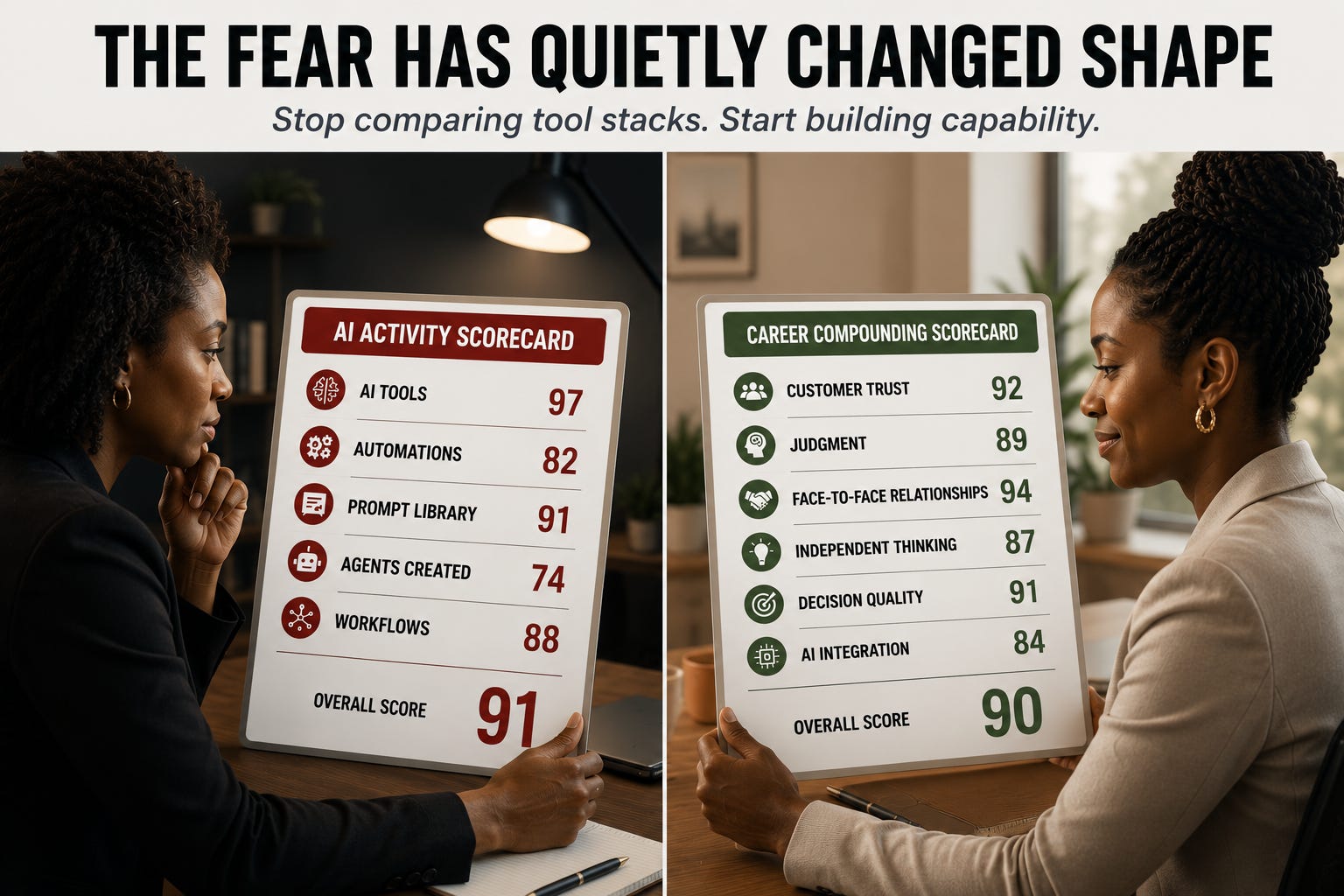
That is the tell. AI fluency has become a status symbol. People are no longer measuring themselves only against their numbers. They are measuring themselves against the sophistication of the person sitting next to them.
Which means the anxiety is not really about AI at all. It is the oldest career fear there is, watching someone nearby move faster and not understanding how.
The divide is already forming
There is a line forming, and it is not the one people think.
It is not between people who use AI and people who do not. Almost everyone has opened the tools by now. The real line runs deeper. On one side are the people who have built AI into how they think, prepare, and review their own work. They are constructing a personal operating system around what they do. They cannot yet prove the gains, but they are building compounding habits.
On the other side are the people still standing at the edge. They open a chatbot now and then, ask for an email rewrite, get a call plan, and go back to working the way they always have. They are not lazy. Many are excellent at their craft. They are just treating AI as a gadget while their peers are treating it as plumbing.
That gap looks small today. It will not stay small. Habits that compound rarely do.
We started celebrating the wrong thing
Here is where the market has gone a little immature.
We are treating adoption as if adoption were the result. People announce that they have been transformed before they can point to a single durable outcome. Not more revenue. Not stronger retention. Not a better experience for the customer on the other end. Just a longer tool list and a louder story.
Apparently, I am naive for still wanting the boring outcomes in the same sentence as the exciting ones. Revenue and wellbeing. Productivity and better judgment. Speed and a buyer who actually felt helped. But if AI is genuinely changing the work, those are exactly the things we should be willing to inspect. Right now, we are mostly measuring excitement and calling it progress.
So basically, enthusiasm is being mistaken for transformation. And enthusiasm fades.
Human skills are the floor, not the ceiling
I still believe the people who come through this will be more human, not less. They will listen harder, think more deeply, and earn trust faster than tools ever could.
But I watch a lot of people turn that belief into a hiding place. Human skills matter, they say, so I am safe. That is where the logic breaks.
Human skills are necessary. They are not sufficient. A professional with strong judgment and real leverage will outwork a professional with strong judgment and no leverage. That is the uncomfortable middle that most people are avoiding. The real question is smaller and harder than man versus machine. Can you add the leverage without handing over the judgment that was the whole point of you?
Because the judgment is the asset. The tools are rentable. Anyone can rent the same model you rent. What they cannot rent is the way you read a room, frame a problem, or know which deal is real. AI should be amplifying that. For too many people, it is quietly replacing it, one outsourced decision at a time.
What this means for your career
This matters most in what I call the Foundation Stage, the decade of work after your first couple of years, when the real structure of a career either gets built or quietly does not.
In that decade, capability compounds or it stalls. The people building AI into their judgment are laying down an advantage that pays off years later. The people treating it as a toy are not falling behind today. They are falling behind on a delay, and the bill arrives later, by which point the gap is too wide to close in a quarter.
More tools will not fix this. The answer is older and duller than the hype. Own the source of your value and use the machine to extend it, rather than outsourcing it. Agency over anxiety. The comparison fear loses its grip the moment you stop measuring your stack against theirs and start measuring whether you are actually getting better.
What I am watching
The winners will not have the longest tool list. They will not be the loudest evangelists either. They will be the ones who turn capability into outcomes. Better conversations. Sharper qualification. Cleaner follow-up. A customer who walks away more confident than before.
That is the divide forming right now. Not users against non-users. Integrators against the people poking at it from the fringe. And even that line will move again, because eventually the only test that survives is whether all this new capability made you a better professional and a better leader.
AI will separate people this decade. For some, it becomes real leverage on a real skill. For others, it quietly exposes that the old strengths were never quite enough on their own. Which one it becomes for you is still, for now, a choice you get to make.
That is the frontier I am watching. And I think you should be watching it yourself.
Related reading: AI Is a Threat to Your Job. But a Bigger Threat to Your Promotion. and The Corporate Deal Is Dead. The Self-Authored Career Is What Replaces It.
Dr. Deepak Bhootra spent 34 years in leadership roles and 14 years as an ICF-certified coach, touching the lives of 1,500 people. Those learnings led him to found RISEUP@work, a career operating system that accompanies professionals throughout the full arc of their working lives, organized into three stages: Launch, Foundation, and Dividend. RISEUP@work is raising capital now, ahead of a revamped platform build aiming for a July launch, with a minimum investment of $100 to keep participation broad. Invest at wefunder.com/riseupatwork.