


The Layoff That Breaks the Pattern
Cloudflare’s CEO Matthew Prince published an explanation for a layoff that fit none of the usual scripts. The company was not struggling. It posted record revenue growth, strong free cash flow, and an unprecedented number of new customers. And it still cut more than twenty percent of its workforce.
Prince noted that there is no example in U.S. business history of a public company growing by more than 30% while laying off more than 20% of its people. Then he said the part that should stop every professional in their tracks. This is going to become the norm.
His explanation was a single, brutal sentence. AI is not coming for builders or sellers. It is coming for the measurers.
The Three-Way Sort
Prince did not invent the framing. He reached back to Peter Drucker’s 1954 classic, The Practice of Management, which sorts the work of any business into three kinds. Builders create the product. Sellers sell it. Measurers do everything else: internal audit, revenue recognition, finance, legal, compliance, middle management, operations, and on and on.
For most of business history, measurement was a deeply human and respected job. Someone had to pull the numbers, audit the risk, write the report, run the review, and coordinate across teams. The middle of every organization swelled with people whose core value was measurement. Here is the irony Prince points to. Drucker argued seventy years ago that value is earned through building and selling, not measuring, and that the best companies would invest most in those two functions. Companies did the opposite, because measurement required humans and lots of them.
That is precisely the constraint AI now removes. Tireless, continuous, objective, and available, it measures better than the people who used to. Prince said the majority of the people Cloudflare cut were measurers. Middle managers, operations, marketing, and parts of finance. And the interns the company hired by the thousand were all builders or sellers.
Most commentary stopped there, treating this as a story about which jobs are safe. That reading misses the far more unsettling implication for anyone thinking about their career.
The Inversion Nobody Is Naming
Here is the part that should change how you think about progression.
For the seventy years since Drucker named these categories, the career ladder has been built to turn you into a measurer.
Think about what a promotion has traditionally meant. You start by doing the work. You build, you sell, you create. And then, if you are good at it, you get promoted away from the work. You become the person who manages the builders, reviews the sellers, measures the output, reports it upward, and coordinates across the organization. Every rung up the ladder moved you further from value creation and deeper into measurement. The org chart is, structurally, a measurement hierarchy.
Which means the destination the entire ladder was pointing you toward is now the most automatable category in the company.
You may well keep your job. The promotion you have been chasing is a different story. It is the first thing AI eliminates, and at companies like Cloudflare, it already has.
This is not a small adjustment. It is an inversion of the safety logic that an entire generation built careers on. The people who climbed fastest into management, who optimized for the next title, who measured their own progress by their distance from the actual work, are now standing on the most fragile ground in the building. Meanwhile, the builders and sellers were promoted away from being the ones getting the offers.
Measuring Is Not the Same as Judging
There is a crucial distinction hidden within Prince’s framing, and it is where the path forward lies.
AI measures. It does not judge.
Measurement is the collection, synthesis, and reporting of what happened. Judgment is deciding what it means and what to do about it. AI is already superhuman at first. It is structurally incapable of the second, because judgment requires accountability, taste, values, and skin in the game, none of which an AI system possesses or can be held to.
The measurer asks what happened and how to report it. The judge asks what this means and what we should do. One of those is being automated. The other is becoming the scarcest and most valuable capability in any organization.
The career mistake is to climb the measurement ladder. The career move is to climb the judgment ladder. They are not the same ladder, and for the first time, they are pointing in different directions.
What This Means for Career Progression
At RISEUP@work, we organize a career into three stages, and Prince’s letter maps onto them with uncomfortable precision.
In the Launch Stage, the trap becomes a process runner. The professional who learns only to execute repeatable tasks is a measurer in training, building exactly the kind of value AI absorbs. The Launch Stage move is to build genuine range and judgment, not procedural competence alone.
In the Foundation Stage, the trap is the promotion itself. This is the stage where the conventional ladder pulls capable people out of value creation and into the measuring layer, calling it success. The new Foundation Stage move is to deepen the value you create and build judgment on top of it, rather than climbing into management for the title. If you do step into leadership, lead as a judge and a multiplier of people, not as a measurer of them. The manager whose only function is measurement is quietly automating their own role.
In the Dividend Stage, the high ground is exactly where AI cannot follow. Leverage, judgment, taste, relationships, direction. The professional who has built these is not threatened by continuous AI measurement. They are the one who uses it, sit above it, and decide what the measurement means. One of the sharper observations on Prince’s post named this directly. The sustainable move is to transition from human operators to system controllers. That is the Dividend Stage in a single phrase.
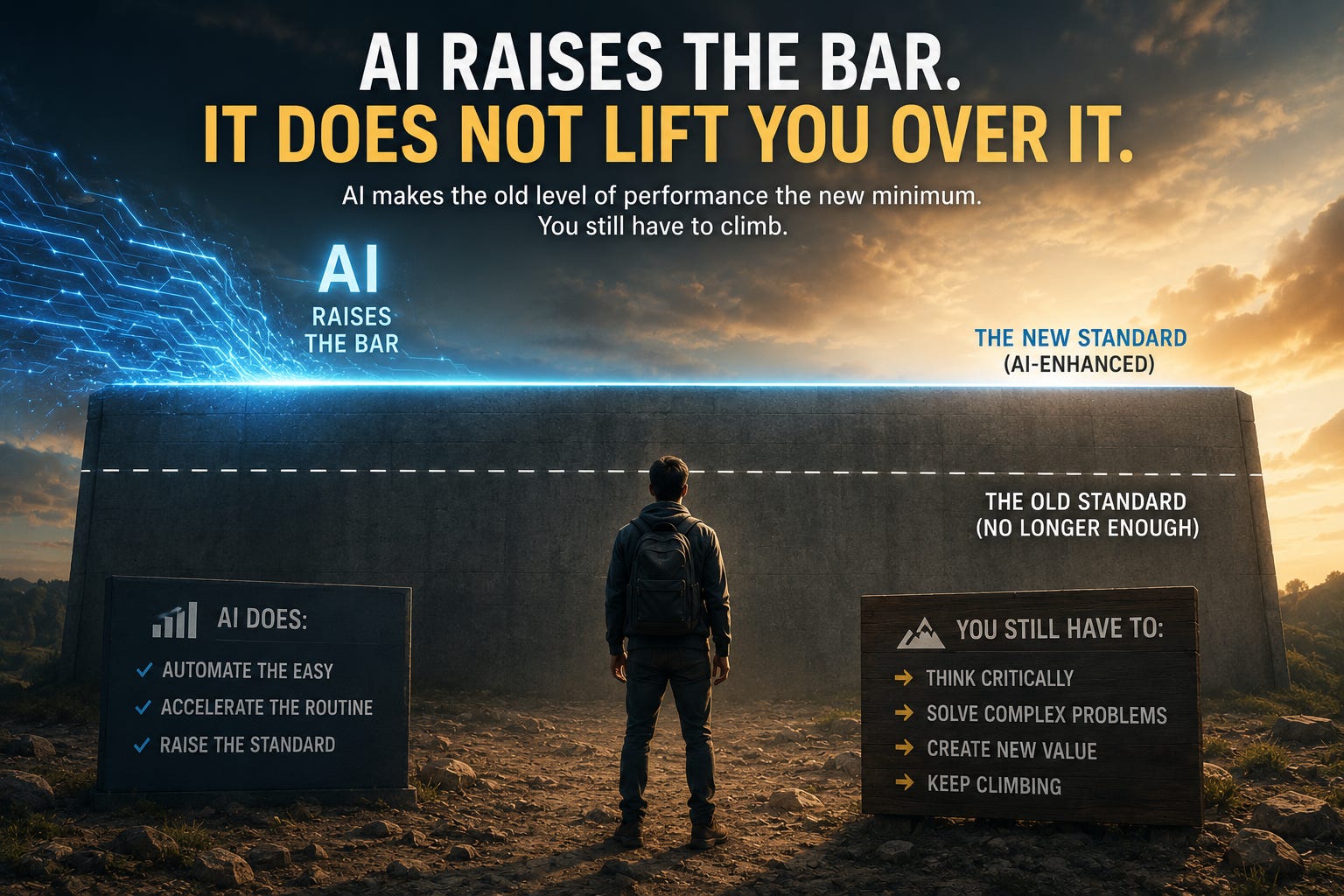
AI Raises the Bar. It Does Not Lift You Over It.
There is an optimistic version of this story, and it is worth taking seriously. AI is not a threat at all, the optimists say. It is an upgrade. It frees us from the drudgery of measurement so we can finally work smarter and better.
That is true, but only for people who are ready.
AI raises the bar for everyone. It does not lift anyone over it. The professional who was already building judgment, range, and genuine value rises with the new tools. The professional who was coasting in a measurer’s role, repeating the same year of work, arrives at the higher bar with nothing to clear it. The same tool produces opposite outcomes, and the difference is readiness, which is earned long before the moment it is needed.
You cannot walk onto the Olympic track without years of preparation behind you. No one reaches the highest level of competition by accident. The athlete who medals trained for it when no one was watching, through the seasons that did not count. The professional who thrives in the AI era is the same. They built the capability before the bar moved.
This is the part the optimists skip. The upgrade is real, but it is not automatic, and it is not evenly distributed. It rewards the prepared and exposes everyone else. The layoff was never the thing to fear, but arriving at the higher bar unprepared was.
Readiness is exactly what RISEUP@work is built to produce. Not motivation, not content, but the intentional preparation that compounds across the three stages, so that when the bar moves, and it will keep moving, you are already standing above it.
The Reframe
The career is an asset. The role is rentable. And the measurer role is now the most rentable, most automatable role in the building.
For decades, professionals were taught to treat the climb into management and measurement as the definition of progress. That definition just became dangerous, and the fix will feel radical to anyone raised on the ladder. Stop chasing the promotion into measurement. Build the opposite. Real progression now means moving toward the capabilities that compound and resist automation. The ability to create genuine value. To build relationships that AI cannot hold. To exercise judgment that someone will actually be accountable for. To direct systems rather than be one.
Prince’s letter reads like a story about layoffs. It is really a story about what a career is for. The professionals who thrive in the next decade will not be the ones who climbed fastest into the measuring layer. They will be the ones who stayed close to value, built judgment, and added leverage on top, while the measurement they used to do by hand quietly became the machine’s job.
The ladder did not just get shorter. It started pointing in a new direction. The work now is to make sure you are climbing the right one.
Dr. Deepak Bhootra spent 34 years in leadership roles and, during that time, spent 14 years as an ICF-certified coach, touching the lives of 1,500 people. Those learnings led him to found RISEUP@work, a career operating system that accompanies professionals throughout the full arc of their working lives, organized into three stages: Launch, Foundation, and Dividend. RISEUP@work is raising capital now, ahead of a revamped platform build aiming for a July launch, with a minimum investment of $100 to keep participation broad. Invest at wefunder.com/riseupatwork.