


Early in a career, everything looks worth chasing.
Every skill, every tool, every opening, every piece of advice from someone a rung above you. You say yes to all of it, partly from hunger and partly from the fear that the one thing you skip is the thing that mattered. At that stage, you have no filter yet, so everything gets a yes.
JP Bristol wrote a piece this week called The Erasing Is the Work, and it named something I have watched in coaching for years. His argument is simple and true. Experience is not about knowing more. It is about knowing what to ignore. He tells the story of Mike, a grocery veteran thirty years his senior, who could sit through a polished software demo and spot the vaporware in a single question, because he had already seen the movie. The most valuable thing on JP’s whiteboard, he realized, was not what he had written. It was what he had erased.
He is right. I want to run his idea straight through a career.
Where JP is right
The part JP nails is that judgment is subtraction. Every yes quietly costs you a hundred invisible no’s, and the people who move fastest are not the ones who weigh every option. They are the ones who eliminated most of the options before the meeting even started. In working life, attention is the scarcest thing you own, and experience teaches you to spend it on less.
I would add only that this has never mattered more. AI has made accumulation free. Anyone can now pull up every article, every framework, every option in seconds. So the thing that used to separate people, simply knowing more, is worth almost nothing now. The only remaining scarce skill is JP’s skill. Knowing what to leave on the board.
The part a career adds
Here is where I want to extend him, because he is writing from thirty-seven years in, and most of the people I coach are not.
Knowing what to ignore is earned, not chosen. Mike could filter that demo in one question because he had sat through a thousand of them first. The scar tissue came before the shortcut. Tell someone in their first job to “ignore more,” and they will ignore the wrong things, because they do not yet have the library of patterns that makes the filter safe.
So the career version of JP’s idea is not a rule. It is a sequence. There is a season for adding and a season for editing, and the whole art is knowing which one you are standing in.
The three seasons of judgment
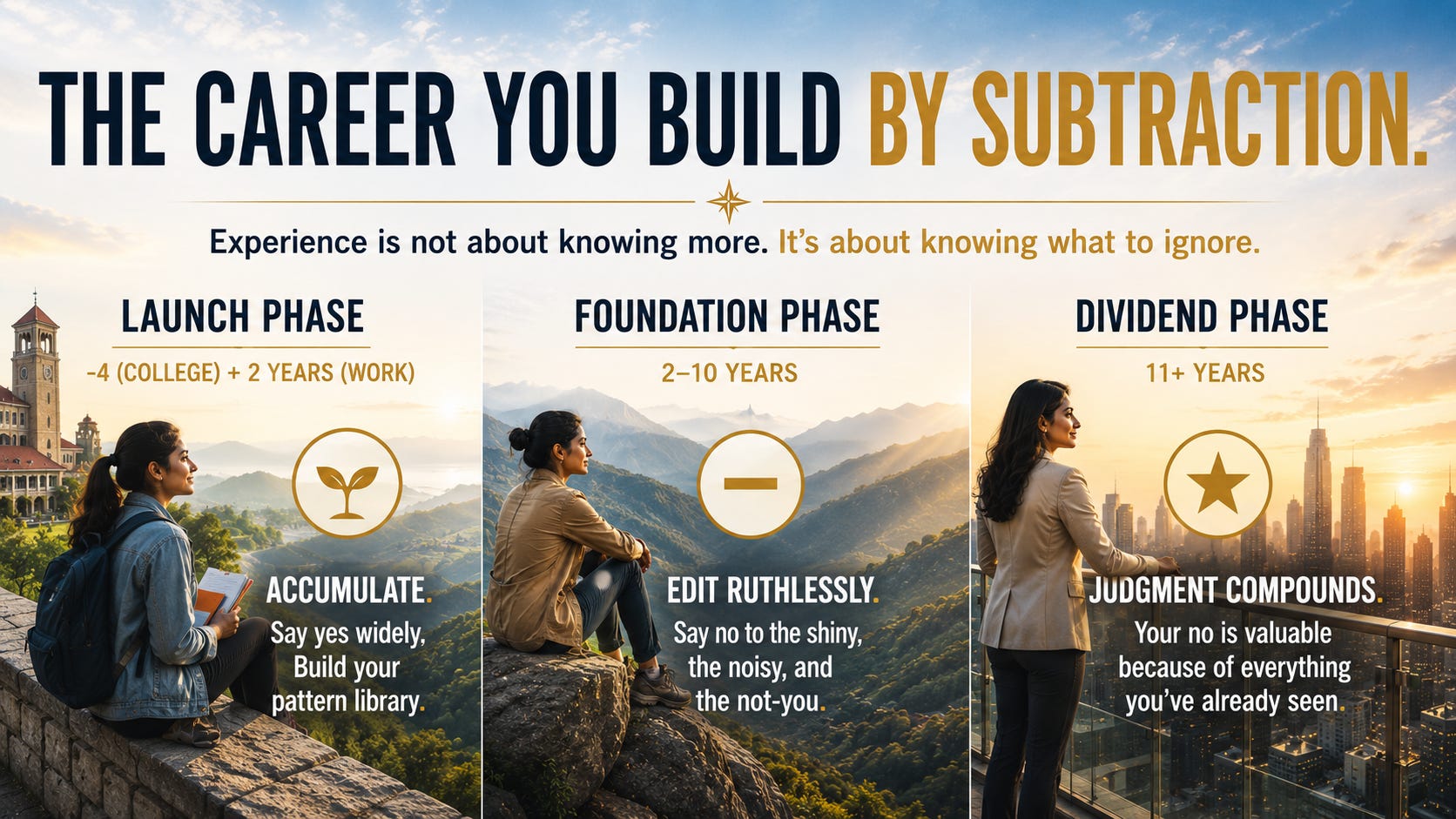
At RISEUP@work, we think about a working life in three stages, and JP’s skill lands differently in each.
In the Launch Stage, the first years, your job is to accumulate on purpose. Say yes widely. Go chase the movie you have not seen yet. You are building the pattern library you will draw on for the rest of your career, and this is the one season when collecting really is the work.
In the Foundation Stage, the decade that follows, the work quietly flips. You have enough scar tissue now to start erasing. The skill becomes saying no to the shiny role that leads nowhere, the tool that adds motion but not judgment, the inherited rule you never actually chose. You start to feel progress in the things you turn down.
In the Dividend Stage, judgment itself is the asset. People pay for what you refuse to chase, because your no is backed by everything you have already seen. You became valuable not by knowing everything, but by becoming very hard to distract.
That arc is the career. It is the slow move from adding to editing, and the people who stall are usually the ones who never made the turn. They are still meeting every new idea at year twenty with the same wide-open hunger that served them at year two. JP watched them at conference tables, exhausted. I watch them in coaching, busy and going nowhere.
The move this week
Pick one thing you are still chasing that experience has already told you to let go of. A skill you keep meaning to learn that your gut knows is not yours. A standing meeting you attend out of habit. An inherited belief about what a good professional must always do. Erase it, on purpose. Then guard the space you just cleared, because it will refill with noise the moment you look away.
That single act is career progression in miniature. Nothing got added to the pile. You just got expensive with your attention, to borrow JP’s phrase.
The close
JP wrote that the world does not get quieter; you do. For a career, that is the whole thing.
You will not build a durable working life by trying to keep up with everything, because nobody can, and the trying is exactly what burns people out. You will build it by deciding, earlier than feels comfortable, what you are willing to ignore, and then trusting the blank space more than the noise. That blank space is judgment, and judgment is the only part of a career that no machine can rent, and no reorganization can take.
Thank you, JP. I have seen this movie too, and it gets better every time I watch someone finally pick up the eraser.
Related reading: AI Is a Threat to Your Job. But a Bigger Threat to Your Promotion. and The Corporate Deal Is Dead. The Self-Authored Career Is What Replaces It.
Dr. Deepak Bhootra spent 34 years in leadership roles and 14 years as an ICF-certified coach, touching the lives of 1,500 people. Those learnings led him to found RISEUP@work, a career operating system that accompanies professionals throughout the full arc of their working lives, organized into three stages: Launch, Foundation, and Dividend. RISEUP@work is raising capital now, ahead of a revamped platform build aiming for a July launch, with a minimum investment of $100 to keep participation broad. Invest at wefunder.com/riseupatwork.