


Where This Started
Nobody provided you with a manual for working alongside AI. You figured out the tool through trial and error, just like everyone else. You opened it, made guesses, and hoped those guesses would eventually translate into some level of skill.
This month, the institution most identified with the technology admitted it cannot hand its own students that manual either.
An MIT faculty committee published a report on the use of AI in teaching, learning, and research training. Five months of work, faculty from every school, written as a call to action. The committee did not soften the ending. Its own summary was that no one, anywhere, has this figured out yet.
One number stopped me. In MIT’s Fall 2025 survey, 70% of students said AI proficiency will matter in their careers. Only 25% believed MIT was preparing them to use it. Which means the best-resourced technical school on earth is missing three of every four of its own people.
The Gap Underneath the Skills Gap
The report is careful about what is breaking. AI can now complete almost any written assignment. So the essay and the problem set no longer prove that a person learned anything.
The committee is blunt about the cost. Overreliance on AI weakens memory, erodes confidence, and undermines mastery. In the same survey, 90% of students were worried about leaning on it too hard. 67% were very worried.
So the students can feel the erosion happening to them. They still cannot stop reaching for the tool.
The report has a name for the reflex. Cognitive surrender. You reach the first hard part, and you hand it over.
This is not only an MIT worry. In a study of 666 adults, the heaviest AI users scored lowest on critical thinking, and the drop was attributed almost entirely to offloading thinking to the tool (Gerlich, 2025). In another study of knowledge workers, the more a person trusted the AI, the less they checked its work (Lee et al., 2025).
So MIT is describing on its own campus what the research is finding everywhere else.
The Youngest Feel It First
A separate campus survey drew about 8,000 responses. Only 23% called themselves optimistic about AI.
The undergraduates, the group closest to the job market, were more likely to say the tool made them feel replaceable than capable, 40% to 34%.
So the people with the most road ahead of them are the most worried about being written out of the story. That is the starting line for anyone in the first decade of work right now.
The First Rung Is Being Sawn Off
The sharpest worry in the whole document is about a program called UROP, undergraduate research that reaches 93% of MIT students. Faculty are weighing whether to replace young researchers with AI agents, because the agents are faster and cheaper.
The committee’s warning is precise. Do that, and you erode the path through which judgment, confidence, and a professional identity are built.
The labor market is already showing the same thing. The Stanford Digital Economy Lab found that entry-level headcount for the youngest workers in the most AI-exposed jobs fell 16%, while older workers in the same jobs held steady.
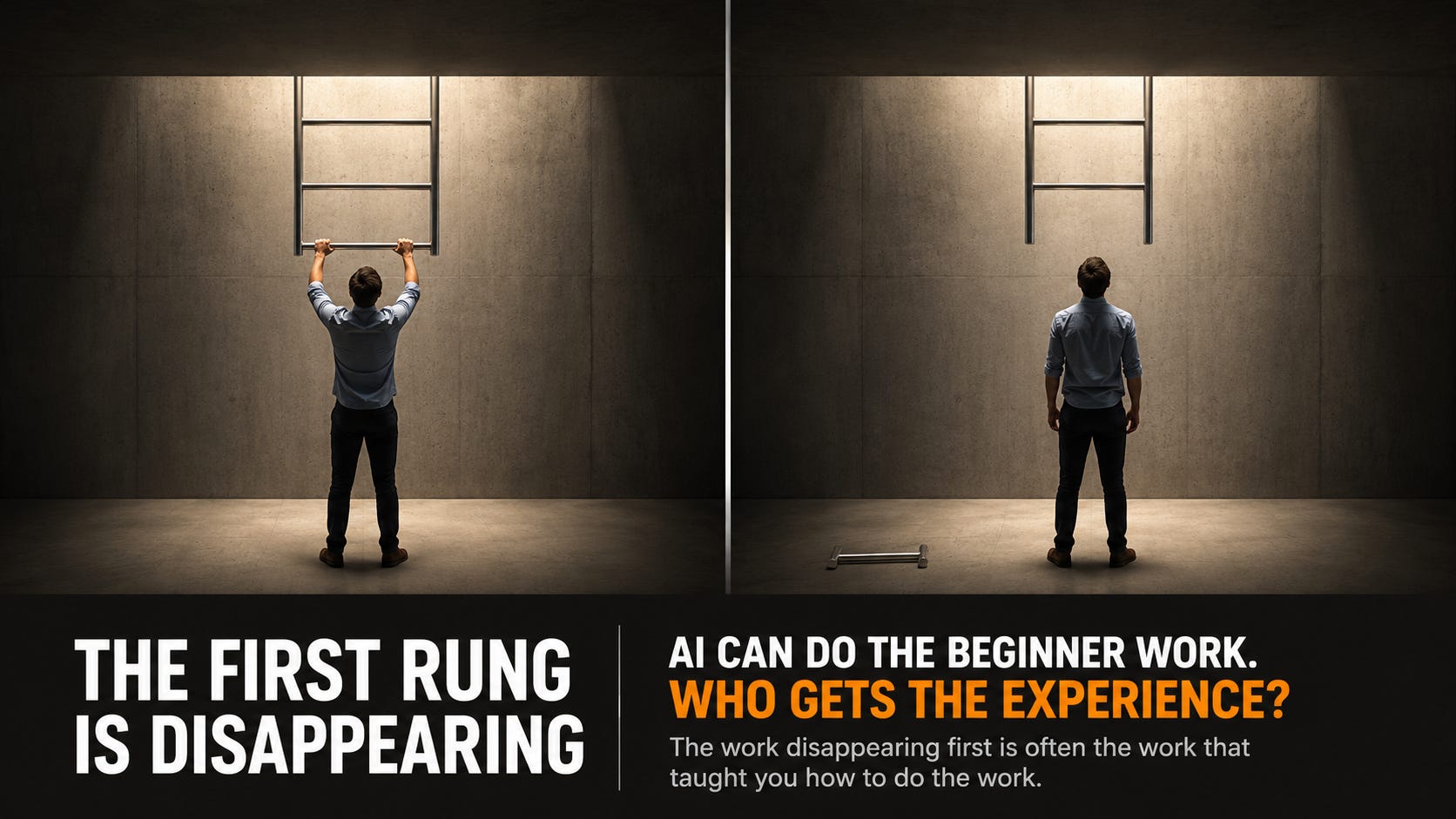
Read it as a career warning, not a campus one. The small, codified work that used to teach a beginner is the exact work AI now does first. Which means the ladder is losing its bottom rung, on both sides of graduation.
What This Reads Like Across a Working Life
At RISEUP@work, we organize working life into three stages, and this hits hardest in the first.
In the Launch Stage, the first years of work, you were supposed to learn by doing the small tasks under supervision. That is the work getting automated.
So the forming that used to arrive free with the job now has to be built on purpose. Nobody is going to schedule it for you.
In the Foundation Stage, the decade after, the gap compounds. Two people who started the same year can end up with very different judgment, while their titles still read the same.
In the Dividend Stage, that accumulated judgment becomes the whole product, and the person who skipped the forming stage has little left to sell.
The instruction the report gives its own faculty is the one that works for a career. Use AI to expand what you can take on, not to skip the thinking that makes you worth hiring.
The Move This Week
Pick one task you would normally hand to AI whole. A memo, an analysis, a plan.
Do the first version yourself. Rough is fine. Then let the tool tear it apart and argue back. You have just used AI to sharpen your judgment rather than rent it. Do that fifty times, and you have the habit the report says almost no one is building.
A Final Frame
MIT can rebuild some of this by hand. It has faculty, funded teams, and a few thousand students to cover.
Most people reading this have none of that. They have a job, a tool that will do the work for them, and no one checking whether they grow.
The report highlights a gap that is growing wider. No one will close it for you. Not the employer improving their results this quarter, nor the school from which you graduated. The tool will complete the task. The forming is still your responsibility to do or choose to skip.
Related reading: AI Is a Threat to Your Job. But a Bigger Threat to Your Promotion. and The Corporate Deal Is Dead. The Self-Authored Career Is What Replaces It.
Dr. Deepak Bhootra spent 34 years in leadership roles and 14 years as an ICF-certified coach, touching the lives of 1,500 people. Those learnings led him to found RISEUP@work, a career operating system that accompanies professionals throughout the full arc of their working lives, organized into three stages: Launch, Foundation, and Dividend. RISEUP@work is raising capital now, with a minimum investment of $100 to keep participation broad. Invest at wefunder.com/riseupatwork.