


Good Work Does Not Speak for Itself
It is a comforting story. Keep your head down, do excellent work, and the right people will notice. Most of us were handed that story early. Most of us are still waiting for the part where it comes true.
Here is the pattern I have watched for three decades. Someone is excellent at the job. They hit every deadline. The work is clean. And they stall anyway, while someone less capable moves past them. They cannot understand it, because they were told the work would carry them.
The work does not carry you. Someone has to be listening, and they have to understand what they are looking at.
That skill has a name people flinch at. Managing up. It sounds like politics. It sounds like flattery, maneuvering, and saying the right thing to the right person. So, good people avoid it and quietly pay for avoiding it.
What managing up actually is
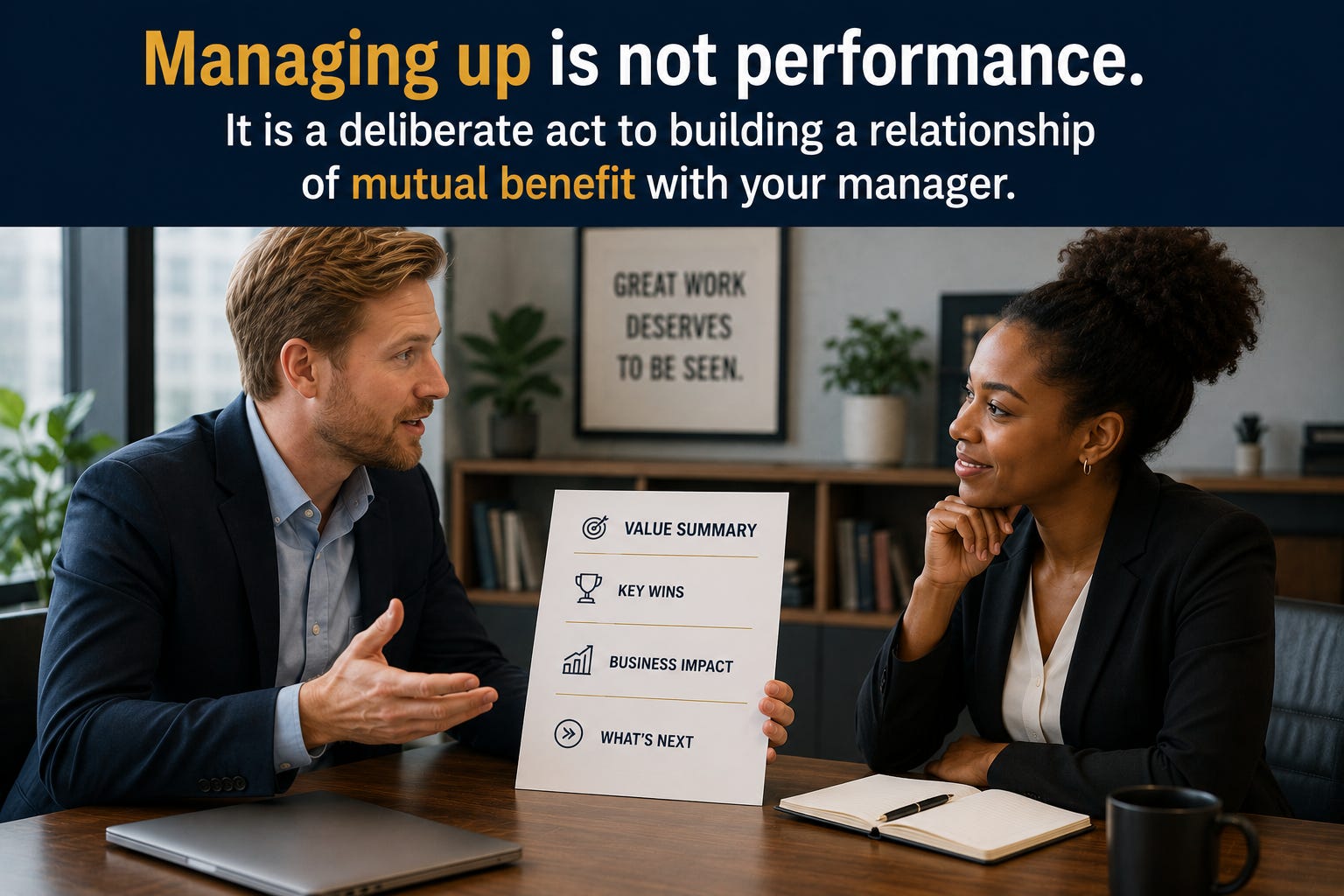
Managing up is not performance. It is the deliberate work of building a real relationship with the person who influences your trajectory, so that your contributions are understood, and your value is visible.
Notice what that is not. It is not sucking up. It is not doing someone else’s job for free. It is taking ownership of how your work lands, rather than leaving it to chance.
And here is the part almost everyone misses. Managing up is not a tactic for your current job. It is how credibility accumulates across a whole career.
Think about what a career actually is. The role is rentable. Your employer rents your time and can stop renting at any point. A career is an asset, a durable and owned source of your value that travels with you from job to job.
Managing up is one of the quiet engines that builds the asset.
The arc this sits inside
At RISEUP@work, we organize work life into three stages. Longitudinal is just a long word for this idea, that your career is one continuous arc rather than a series of disconnected jobs. The Launch Stage is the first few years, when you are forming the raw material. The Foundation Stage is the decade where the real structure gets built. The Dividend Stage is when what you built starts paying you back.
Managing up in the Launch Stage is not about getting one promotion. It is laying down a credibility ledger. Every time your manager understands your value, that entry compounds. By the Dividend Stage, that ledger is the difference between someone who gets pulled upward and someone who keeps explaining why they deserve to be.
So, basically, the conversation you have with your manager this quarter isn’t about this quarter. It is a deposit.
COMPASS: the discipline underneath it
In my book, RISEUP: Your Career Reclaimed, I lay this out as a framework called COMPASS. It exists because most people manage up on instinct, and instinct collapses the moment a conversation gets tense. COMPASS turns it into something you can intentionally repeat. Seven moves.
C - Context Awareness. Every manager carries pressure you cannot see, from their own boss, their targets, and their peers. Read it. The moment you understand what keeps them up at night, you stop adding to the pile and start taking things off it.
O - Organizational Alignment. Stop describing your work as if it lives in its own bubble. Tie it to what the business is actually trying to do, in words your manager can repeat upward without having to translate. When your boss can explain your value to their boss in one sentence, you become someone worth investing in.
M - Messaging Strategy. Their day is chaos. When you get five minutes, do not just hand them a problem and walk away. Bring the problem and two ways to solve it. Be the five minutes that made their day lighter, not heavier.
P - Proactive Credibility. Trust is not built in the big moments. It is built in the small ones. On time, as promised, again and again, until reliability is simply assumed. Then, when the high-stakes moment comes, you already have credit to spend.
A - Adaptive Style. Some managers want everything in writing. Others want to talk it through. Some need all the data before they move, some trust their gut. Work out how yours takes in information, and when you are not sure, ask them directly how they want to hear from you. Almost nobody thinks to ask.
S - Stakeholder Mapping. Your manager does not decide in a vacuum. They are absorbing pressure from above and across, from people you may never meet. The better you understand that web, the more you can help them move through it, and the more valuable you become to them.
S - Self-Groundedness. This is the one almost everyone skips, and it is the one that matters most. Managing up is not about becoming someone else to get ahead. It is being yourself, more strategically. You adapt your delivery. You never trade away your values.
That last move is the whole RISEUP thesis hiding inside a tactical chapter. The quiet danger in all career advice is that you shape-shift to fit each manager until there is nothing left that is actually you. COMPASS is built to prevent exactly that. The goal is agency over anxiety. You remain the source of your own value while making that value legible to the people who decide.
Read the seven again and notice what they are not. None of them is flattery. None is volume. Managing up is not about being louder or smoother. It is about being understood by the one person whose understanding compounds.
The move this week
Pick your next meaningful conversation with your manager. Before it, ask one question: What would you need to see from me to know I am ready for the next level? Then choose one thing from their answer and start doing it visibly.
That is the entire discipline in one motion. You made your value legible. You took ownership instead of waiting. You added an entry to the ledger.
Good work does not speak for itself. It never did. The forming is yours; the work is yours, and making it seen is yours, too. That is not politics. That is owning the source of your value.
Related reading: The Corporate Deal Is Dead. The Self-Authored Career Is What Replaces It. and AI Is a Threat to Your Job. But a Bigger Threat to Your Promotion.
Dr. Deepak Bhootra spent 34 years in leadership roles and 14 years as an ICF-certified coach, touching the lives of 1,500 people. Those learnings led him to found RISEUP@work, a career operating system that accompanies professionals throughout the full arc of their working lives, organized into three stages: Launch, Foundation, and Dividend. RISEUP@work is raising capital now, ahead of a revamped platform build aiming for a July launch, with a minimum investment of $100 to keep participation broad. Invest at wefunder.com/riseupatwork.