


Graded on a Dead Year
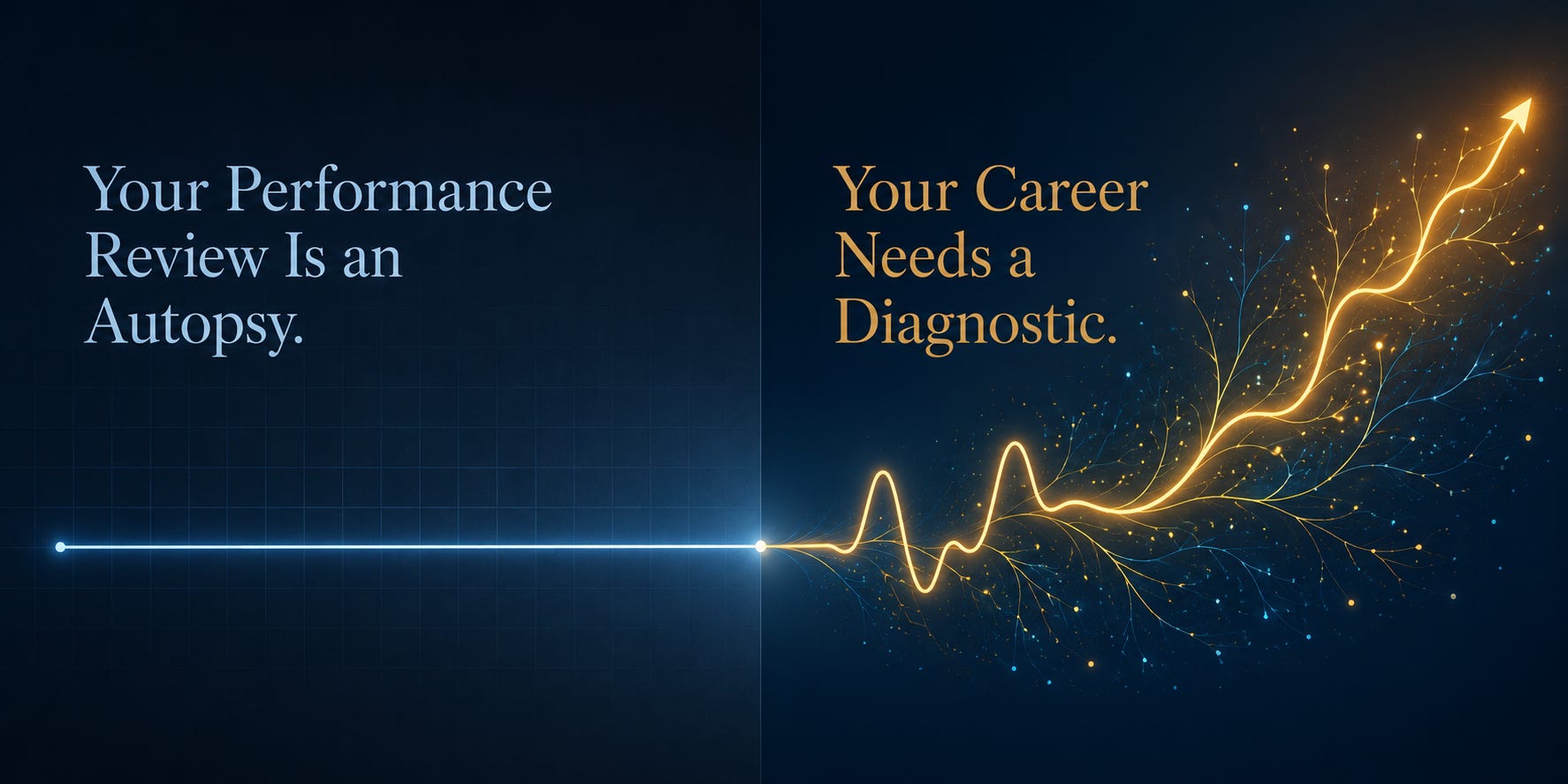
Once a year (or once a Quarter or Month, if you are lucky), someone sits across from you and grades a stretch of time that is already over. The work is finished. The decisions are made. The year is dead, and you are being handed the autopsy.
Almost everyone treats that document as the verdict on their career. That is the mistake. The performance review was never designed to help you grow. It was built to rank you, to distribute pay, and to protect the company in a dispute. Development is the word stapled to the front, so the exercise feels generous. Underneath, it is measurement, and measurement looks backward at output it can no longer change.
I spent 34 years in senior leadership across four countries, and 14 years coaching professionals through the arc of their careers. The pattern never breaks. The review measures the dead year. The career needs something the review was never designed to give. A reading of what is happening now, while you can still act on it.
Why the Autopsy Persists
The review survives because it serves the institution, not the individual. Managers are rewarded for visible responsiveness and short-term output, not for building durable capability in their people. Then bias finishes the job. Recency makes the last three weeks outweigh the prior six months. The halo effect lets one visible strength hide a real gap. Feedback arrives too late to change the outcome it describes, so the whole ritual becomes a source of anxiety rather than a tool for progress.
The numbers confirm it. Only about twenty-three percent of employees worldwide are engaged at work. When you score performance without accounting for the invisible constraints around it, role clarity, resource access, and manager support, you are not measuring the person. You are measuring their environment and blaming them for standing in it.
The Part Nobody Tells You
Here is the conclusion that should change how you operate. If the instrument is backward-looking, automatable, and built for the company rather than for you, then waiting for it is one of the most dangerous habits in your career.
The corporate deal that promised your employer would steward your growth is gone. The ladder that promised the climb into management was progress, but now leads to the layer where AI automates first. Strip away every external structure that once supported a career, and one asset remains standing. You. The source of your value was never the title or the role. It was always you, and everything falling away has only made that clearer.
That is the pivot, and it is a pivot from anxiety to agency. Stop waiting for the autopsy. Learn to run your own diagnostic. You still own the source of your value, which means you still have a say, and intentional diagnosis is how you exercise it.
What a Diagnostic Actually Does
A diagnostic is the opposite of an autopsy in every way that matters. It looks forward instead of back. It runs continuously instead of once a year. It examines the conditions that create output, not just the output itself. And it is built for the person, not the institution. Three shifts do most of the work.
The first is from output audits to system diagnostics. Instead of asking whether you hit your goals, it asks what is actually blocking you from exceeding them, the recurring friction in role clarity, decision speed, and access that no annual score ever captures. That moves the focus from your failure to the system’s friction, and it hands you a map to fix the environment rather than absorb the blame for it.
The second is from a verdict to self-knowledge. The autopsy tells you how you were seen. A diagnostic tells you who you are becoming, where your judgment is sharp and where it is thin, what kind of work compounds your value and what quietly erodes it. We call this inner engineering, the deliberate building of the human underneath the work. It is the half of an AI-era career that no agent can do for you, and it is the half that increasingly decides everything.
The third is from a single year to the full arc. A career is not graded in twelve-month blocks. It compounds across decades, through three stages we call Launch, Foundation, and Dividend. A diagnostic run continuously across that arc protects what we call career net worth, the compounding total of your earning power, judgment, relationships, reputation, and optionality. Run without it, and a career does not stay flat. It quietly erodes. The advantage of consistently better decisions is what we call Return on Clarity, and it is the entire point.
The Hidden Tax, and the Market Underneath It
There is a cost to running the autopsy, and organizations pay it in the form of churn. People do not only leave bad managers. They leave opaque careers, the ones with no visible path forward. PwC’s workforce research found that roughly 44% of workers are ready to change employers within a year, most of them seeking development they cannot find where they sit. The World Economic Forum projects that a large share of worker skills will be disrupted by 2030. A backward-looking review cannot spot a skill gap before it becomes a failure, because it only sees work already done.
Now widen the lens to the market. There is an enormous apparatus built to help people get hired. Resumes, job boards, recruiters, interview preparation, and an entire industry pointed at the offer letter. There is almost nothing built to help people grow once they are inside. That is the white space. Post-hiring career growth, the long arc that begins the day the offer is signed, is the stretch the whole talent industry has left unserved. It is precisely where the diagnostic belongs, and it is what the organizations that intend to keep their best people will be running within the decade.
This Is the Platform We Are Building
I am not describing this gap from the outside. RISEUP@work exists to close it.
The RISEUP Career Diagnostic is the productized version of everything above. It reads where a professional actually stands, where they are pointed, and what is blocking their growth, and it does so continuously rather than once a year. It pairs that diagnosis with AI tools, human coaching, and a peer community, and it accompanies the professional through all three stages of working life. It treats a career as a system to be diagnosed and tuned, not a verdict to be delivered once a year and survived.
This is the asset we are building, and its market is large and structurally underbuilt. The professional who learns to run their own diagnostic stops waiting to be graded and starts compounding on purpose. That is the shift from anxiety to agency, made into a system rather than left to personality. It is why we built the diagnostic first, and why we believe the company sits at the front of one of the most underserved markets in the world of work.
The Imperative of Clarity
Organizations that keep running the annual autopsy will end up staffed by people quietly waiting for the next recruiter to call. And professionals who keep waiting for the autopsy will keep handing the most valuable asset they own to an instrument designed to serve someone else.
Your work world changed. Your contract with the company changed. It is easy to believe you no longer have much of a say in it. You do. You still own the source of your value. The autopsy belongs to them. The diagnostic belongs to you. Build it on purpose.
Dr. Deepak Bhootra spent 34 years in leadership roles and 14 years as an ICF-certified coach, touching the lives of 1,500 people. Those learnings led him to found RISEUP@work, a career operating system that accompanies professionals throughout the full arc of their working lives, organized into three stages: Launch, Foundation, and Dividend. RISEUP@work is raising capital now, ahead of a revamped platform build aiming for a July launch, with a minimum investment of $100 to keep participation broad. Invest at wefunder.com/riseupatwork.