


I sat down with Mazar at Deal Insider’s Capital Deal Showcase for what was supposed to be a quick founder interview. He asked seven questions in eight minutes. No preamble. No softeners. The problem. The moat. The bottlenecks. The revenue model. The three-to-five-year picture. The use of proceeds. And why is any of this investable at all?
I have done a lot of these conversations. This one was useful in an unusual way. The seven questions, in the order Mazar asked them, form a complete argument for why RISEUP@work has to exist and what it has to be to be worth building. This piece is the argument laid out long.
The video is here:
1. The Premise. Thirty-Seven Percent.
Most career platforms describe themselves with the language of self-improvement. Confidence. Wellness. Burnout recovery. Skill building. The vocabulary is morally clean and economically lazy. It frames career work as something you do to feel better, when the truth is that career work is the largest single financial decision most professionals ever fail to make consciously.
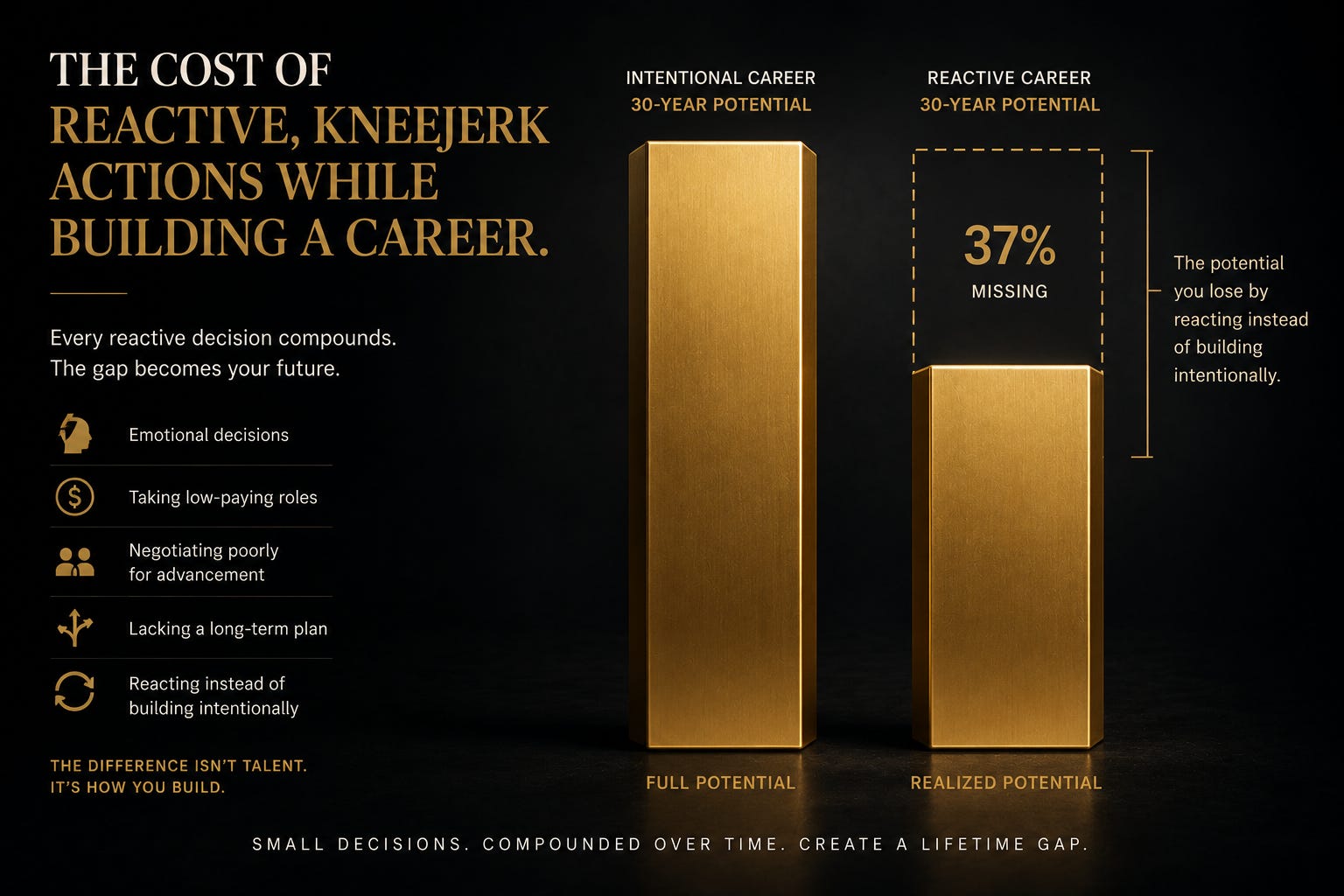
Our modeling, based on standard inflection points over a thirty-year working life, shows that treating the first decade of a career as a series of reactions rather than a plan leaves roughly thirty-seven percent of lifetime net worth on the table. Not thirty-seven percent of one year of earnings. Thirty-seven percent of everything the career was structurally capable of producing.
That number is not motivational. It is the floor of the argument. If the number is wrong, RISEUP@work does not need to exist. If the number is roughly right, then a thirty-year career without a planning system is a thirty-year financial asset built on improvisation, and the professionals who improvise pay a tax their better-planned peers do not pay. Every other claim in this piece is downstream of that single sentence.
The natural follow-up is the obvious one. If the cost is that high, why has nobody built the system? The honest answer is that until very recently, it was not buildable at consumer prices. The expensive parts (diagnostic depth, coaching, longitudinal memory of who you actually are at work) sat behind a five-figure executive coaching engagement. The Launch Stage professional could not afford the thing that would have most protected them, so they did without it, and the tax compounded.
2. The Moat. Integration Beats Features.
When investors look at this category, the first reaction is almost always the same. The space is crowded. LinkedIn already does jobs. Coursera already does courses. A general AI assistant will answer whatever you ask it. A hundred resume tools. A hundred interview tools. Why does another one matter?
The diagnosis lives at the level of features. The real picture lies in how a working professional uses tools throughout their career.
LinkedIn is a career identity platform. It is not a career progression platform, and it has never claimed to be one. It knows what you choose to tell it. It does not know how you think, how you operate under load, how you negotiate, or how your story shifts between Year +3 and Year +7. Coursera is a credential platform. A general AI assistant is an answer machine that forgets you the moment you close the tab. Each is excellent in its slice. None of them holds the relationship.
The seven or eight tools a working professional actually needs (diagnostic, resume builder, LinkedIn optimizer, interview simulator, voice journal, peer cohort, coaching, longitudinal memory) are spread across seven or eight separate subscriptions, none of which talk to the others. The professional pays for fragments and assembles the system in their head, badly. Most assemble nothing and rely on a friend at 10 p.m.
What we are building is the integration. One environment. One running memory of who you are at work. One AI orchestration layer that hands work between tools without losing context. The relationship is longitudinal, meaning a system that walks alongside the same person for years and gets sharper about that person each quarter, rather than starting over each time they open a new tab. The moat is not a single tool. The moat is what happens when those tools stop being islands.
Features are commoditizing fast. Integration is not.
3. The Buyer Has Changed.
There is a deeper reason this is buildable now, but not five years ago. The buyer changed.
For four decades, the corporate coaching market has been sold to enterprises. HR bought programs. Executives got a seat at the leadership development table. Everybody below the executive line got handed an inspirational book and a one-day workshop. That market is being disintermediated in real time. I wrote at length about why in The Corporate Deal Is Dead. The Self-Authored Career Is What Replaces It. The implicit contract has expired. Stewardship of the career has been returned to the professional. The company will not architect your working life. You will.
What has shifted in parallel is professionals’ willingness to act on it. The same person who used to wait for HR to send a coach now expects to own the tools that own their career. They have already lived the Canva moment, the Gamma moment, and the Notion moment. They know what consumer-grade software is supposed to feel like. They are not waiting for permission. They are looking for the system.
That shift is the part most incumbents have not yet metabolized. LinkedIn is not built for it. The legacy enterprise HR platforms are not built for it. The big learning platforms are built for the enterprise buyer who no longer holds the steering wheel. The next decade of category leadership in this space will be claimed by whoever takes the professional seriously as the buyer of their own career operating system. That is the customer we are building for. That is the puck we are skating to.
4. The Product Is Built Around the Person, Not the Task.
Most career tools are task-shaped. A resume tool builds a resume. An interview tool runs an interview drill. A LinkedIn optimizer optimizes a profile. The tool finishes its task and forgets you. The next time you need help, you start over.
RISEUP@work is built around the person. The diagnostic surfaces the behavioral patterns underneath the resume. The AI Interview Simulator does not just run mock questions. It pressure-tests how you actually answer under load and feeds that pattern back into the orchestration layer. The Voice Journal captures what is in your head between sessions, because the most important career data is the kind that never makes it into a form. The peer cohort gives you the stage on which the work gets seen. The coaching layer is human where humans matter, and AI where AI scales, with a careful handoff between the two.
The product gets sharper the longer it knows you, because the asset is not the tool. The asset is the model of you that the system carries across years. The same dynamics that made the consumer AI category boom (memory, personalization, voice) are the ones that finally make a Launch Stage career operating system economically viable. The price comes down to a subscription that fits a real budget. The depth goes up because the system does not have amnesia.
This is also why the revenue model works. Recurring subscription at the entry tier, with a coaching upsell on top. The Launch Stage professional cannot write a $3,000 coaching check, so we meet them at a subscription price. As they grow economically, the platform grows with them. From human in the loop, to AI in the loop, to humans wrapping the AI again at the highest tier. The model is designed to match the arc of a career, not to extract maximum revenue at the moment of greatest fragility.
5. Why This Is Now Investable.
A category becomes investable when three conditions are met simultaneously. The pain is large. The technology is finally adequate. And the buyer is awake.
Pain. A thirty-seven percent lifetime net worth tax on professionals who do not plan, paid silently across thirty years. There is no larger consumer financial problem hiding in plain sight.
Technology. AI has compressed the cost of doing serious career work by an order of magnitude. The same diagnostic depth that used to require eight hours with a human coach can be achieved through an orchestrated session that takes a fraction of the time and is priced for consumers.
Buyer. The professional has stopped waiting for the employer to be the architect. They are reaching for the tools themselves. They are willing to pay for them. They are punishing the tools that do not understand them.
We are heads down on a July 2026 platform launch. The wait list is approaching the thousand mark, and the target is five thousand by launch day. Engineering is funded through a partner equity arrangement. The next half a million dollars of capital goes into the marketing and ecosystem layer that converts demand into a customer base. The trajectory we are underwriting is 5,000 to 10,000 paying customers and $6.2 million to $6.8 million in ARR within three to four years. That is the line at which the unit economics stop crawling and start extrapolating.
What the Eight Minutes Actually Said
The seven questions Mazar asked were not a marketing exercise. They were the standard battery for an investor doing diligence on compressed timelines. Problem. Moat. Bottleneck. Revenue. Trajectory. Use of proceeds. Why now.
The reason the conversation is worth watching is not the answers. It is the order. In eight minutes, the conversation traces the entire argument for why RISEUP@work must exist, what it must be, and why this is the moment to build it. If you have not watched it yet, the link is at the top of this piece.
The argument I made on tape is the same one I am making here. The career is the asset, not the role. The role is rentable. The career is yours. Until very recently nobody could build the operating system for it at a price the right buyer could pay. Now they can. Someone is going to. We are.
That is the existence argument.
The value argument is simpler. 37% of a lifetime is too much to leave on the table because the tools were not yet built. They are being built now. The professionals who use them will, over the next thirty years, look back on this decade as the one in which their working life quietly changed shape.
Dr. Deepak Bhootra spent 34 years in leadership roles and 14 years as an ICF-certified coach, touching the lives of 1,500 people, and those learnings led him to found RISEUP@work, a career operating system that travels with professionals across the full arc of their working life and is organized around three stages: Launch, Foundation, and Dividend. We are raising funds now to build the revamped platform for a July 2026 launch. The minimum investment is $100, set to broaden participation. Back the round at wefunder.com/riseupatwork.