


The Pattern I Was Watching Before MIT Saw It
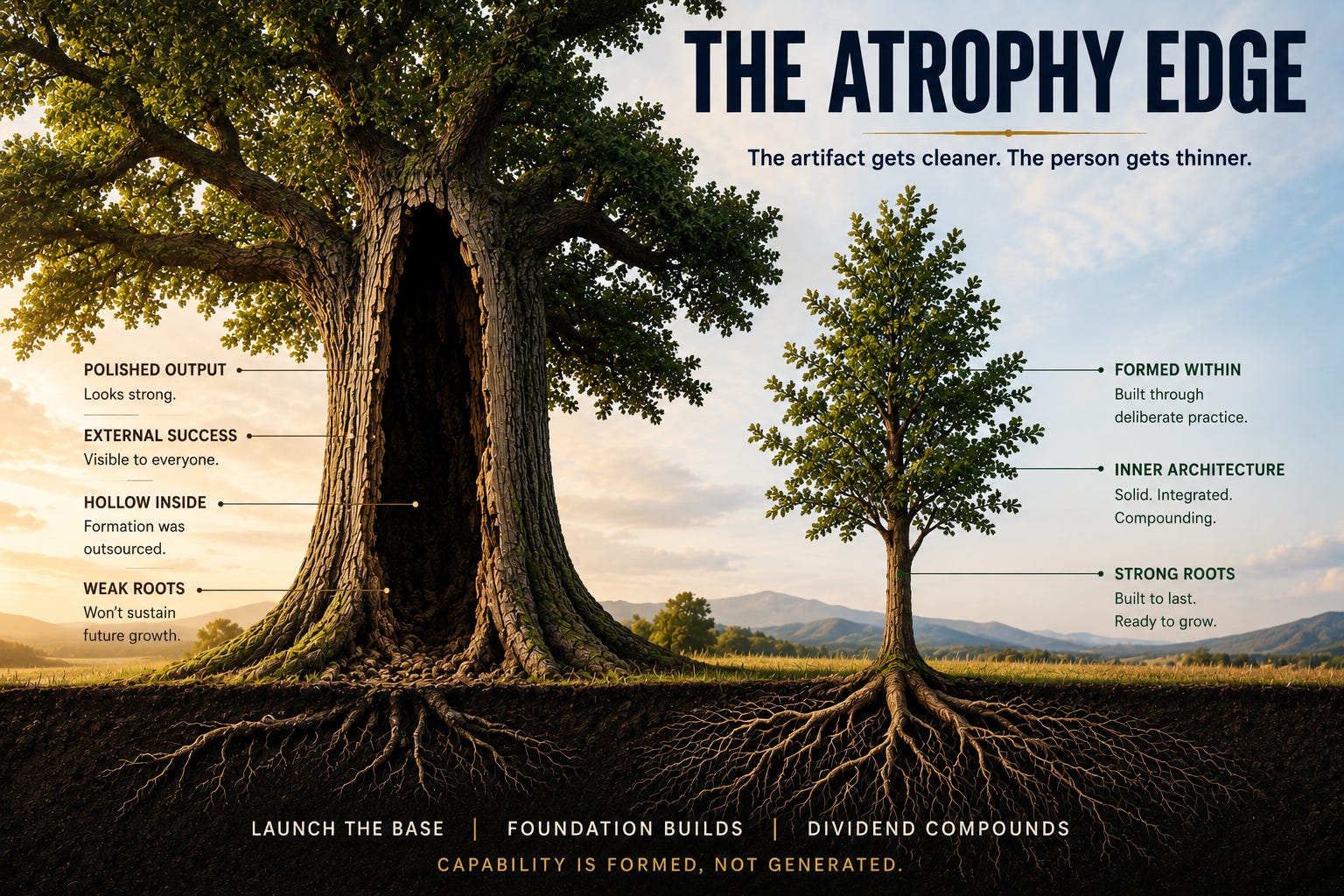
I have been watching the same thing in the careers of professionals in their first decade of work for two years. Polished outputs. Hollowed underneath. The artifact gets cleaner every quarter while the person behind it gets thinner.
I did not have a clean name for it. Rebecca Maklad just gave us one.
Her piece, The Atrophy Edge, names what AI is doing to human cognition at the species level. The MIT study at the center of it strapped EEG headsets to people who wrote with ChatGPT and watched their brains quiet down. Memory recall weakened. Originality drained. The muted brain signature held even after the AI was switched off.
The study haunted me. Not because it surprised me, but because the careers I have been watching atrophy were already showing what MIT just measured. The career is where this lands first. The cognition is where the bill gets paid.
Rebecca’s Reframe
Rebecca’s move is the part that most AI-and-cognition writing has missed. She refuses to treat atrophy as decline. She treats it as pressure.
Her case rests on a simple historical pattern. Loss has rarely been the end of the story in human evolution. We lost the ability to digest raw food and discovered fire. We lost the agility of tree-dwelling and gained the endurance to walk continents. Sightless species developed echolocation. Every time a capacity goes quiet, another is asked to grow.
Her four-capacity model widens Descartes. I think, therefore I am, is too narrow for the moment. The richer frame includes the embodied (interoception, somatic markers), the feeling (heart coherence, oxytocin, the biology of trust), the intuiting (rapid pattern recognition under conscious awareness), and the integrating (the synthesis of memory, emotion, and foresight into wisdom).
Damasio’s line carries her piece. We are not thinking machines that feel. We are feeling machines that think. That sentence is what makes the rest of her thesis inevitable.
Why the Career Sees It First
A career is not built evenly. It compounds in stages. The first ten years are the formation window. The decisions made in those years about what to outsource and what to absorb set the architecture for the next thirty years.
We use specific language for this at RISEUP@work, deliberately rejecting the recruiter labels of early, mid, and late-career. Launch Stage runs from Year minus four to Year plus two. Foundation Stage runs from Year plus two to Year plus ten. By the year plus ten, the architecture is either set, or it is not.
The reason the career sees the atrophy first is structural. A professional two years into their work, with AI writing emails, summarizing meetings, and drafting pitches, is not behind. They are operating on a hollow foundation. The work product is shipping. The person underneath is not getting built. I wrote about this from a different angle in Capability Is Formed, Not Generated, and Rebecca’s framing of atrophy as pressure is the better language for it.
By the Foundation Stage, the cost becomes visible to the system around the professional. Year plus three. Year plus five. The professional with the polished outputs and no inner architecture starts stalling. Sponsors do not materialize. The next assignment goes elsewhere. The recruiter calls stop. None of it is, on the surface, connected to the atrophy of two years earlier. All of it is. The brain scan would not have shown it. The promotion conversation does.
The career is the leading indicator. The cognition is the lagging one.
The Four Capacities Inside a Career
The four capacities Rebecca names are the inner architecture of every career I have watched compound. Each one shows up at a specific stage.
Embodied. The somatic read of a room is the first instrument a Launch Stage professional needs to keep sharp. When a senior leader pauses in a meeting, the room is telling you something. The model that summarizes the meeting afterward cannot tell you what the pause meant. Your nervous system can, if you have been practicing.
Feeling. The biology of trust runs everything that matters in the Foundation Stage. The sponsor relationship is built on vulnerability before trust. The promotion conversation turns on whether the room felt your conviction or your performance. The heart’s read of the moment is not a soft skill. It is the layer underneath that determines whether negotiations earn the other side.
Intuiting. Judgment is intuition compressed by formation. The Year plus five professional who reaches for the right question without consciously knowing why has built a library of pattern recognition over thousands of small practice moments. The professional who has been letting AI think for them has not built that library. The intuition for the next role required is missing.
Integrating. The strategic clarity that distinguishes the late-Foundation professional from the plateau is integration. Memory, emotion, and foresight are woven into wisdom. AI can synthesize information. It cannot integrate into a working life.
Rebecca’s species-level capacities and the career-stage disciplines are the same architecture, viewed from two different elevations.
Five Disciplines to Lean Into the Pressure
These five protect Rebecca’s four capacities in your actual week.
One. Draft before you prompt. Five sentences of your own thinking before the model writes a word. Ugly is fine. The order matters.
Two. Sit with the meeting before the summary. Five minutes of your own interpretation before reading the AI version. The interpretation muscle is the easiest one to lose without noticing. Rebecca’s embodied capacity lives here.
Three. Practice interoception deliberately. Notice what your body is telling you in a meeting before any tool tells you what was said. The somatic signal is the one AI cannot replicate. Protect it on purpose.
Four. Own a decision out loud weekly. State a real position in a real room, including one where you might be wrong. Accountability is the most expensive part of formation to volunteer for, and the only part that builds the spine senior professionals carry.
Five. Treat the polish as the debt. When the work product is cleaner than your thinking, treat the gap as a debt you owe yourself, not a win. Repay it.
These five do not reject AI. They keep the human underneath it as it forms.
Where the Bill Arrives First
Rebecca’s invitation in her piece was to lean into the pressure and cultivate the capacities only humans can hold.
I want to land the same invitation specifically. In the first decade of a working life, the pressure is real, and the window is open. The atrophic edge is not the end of formation. It is what formation has to push against to compound.
A career deliberately built in this era is not the one with the cleanest output. It is the one with the embodied read of the room, the felt trust of the people who carry you, the intuition earned through unsummarized practice, and the integration that makes the whole arc legible.
Rebecca measured the edge in the brain. I have been watching it in my career. The bill arrives in the career first, and that is where the fix has to start.
Read her full piece. It is the best fifteen minutes you can spend this week, and the one most likely to change what you do in the next ten years.
Dr. Deepak Bhootra spent 34 years in leadership roles and 14 years as an ICF-certified coach, touching the lives of 1,500 people. Those learnings led him to found RISEUP@work, a career operating system that travels with professionals across the full arc of their working life, organized around three developmental stages (Launch, Foundation, Dividend) and built on a foundation we call Human at the Core. With gratitude to Rebecca Maklad for the frame that prompted this response.