


You Are Playing the Wrong Game
Scroll LinkedIn for five minutes. You will see the same post a hundred times.
Ten signs of a toxic boss.
Mental health tips over a sunset.
Productivity carousels in identical templates.
They rack up likes. They almost never produce a sponsor, a promotion, a recruiter call, or a decision-maker who actually remembers your name.
You’re not late with your posts, but you are putting genuine effort into a game designed for someone else.
The dominant LinkedIn posting advice was written by creators, for creators, about how to sell things to other creators. Most of the people teaching LinkedIn growth are paid by other people teaching LinkedIn growth.
It is a circular firing squad. Vanity metrics for an audience of sellers.
Your job is not to sell content. Your job is to build a career. This piece is a working playbook for the first ten years of doing that. It is messy. It can be made to work for you.
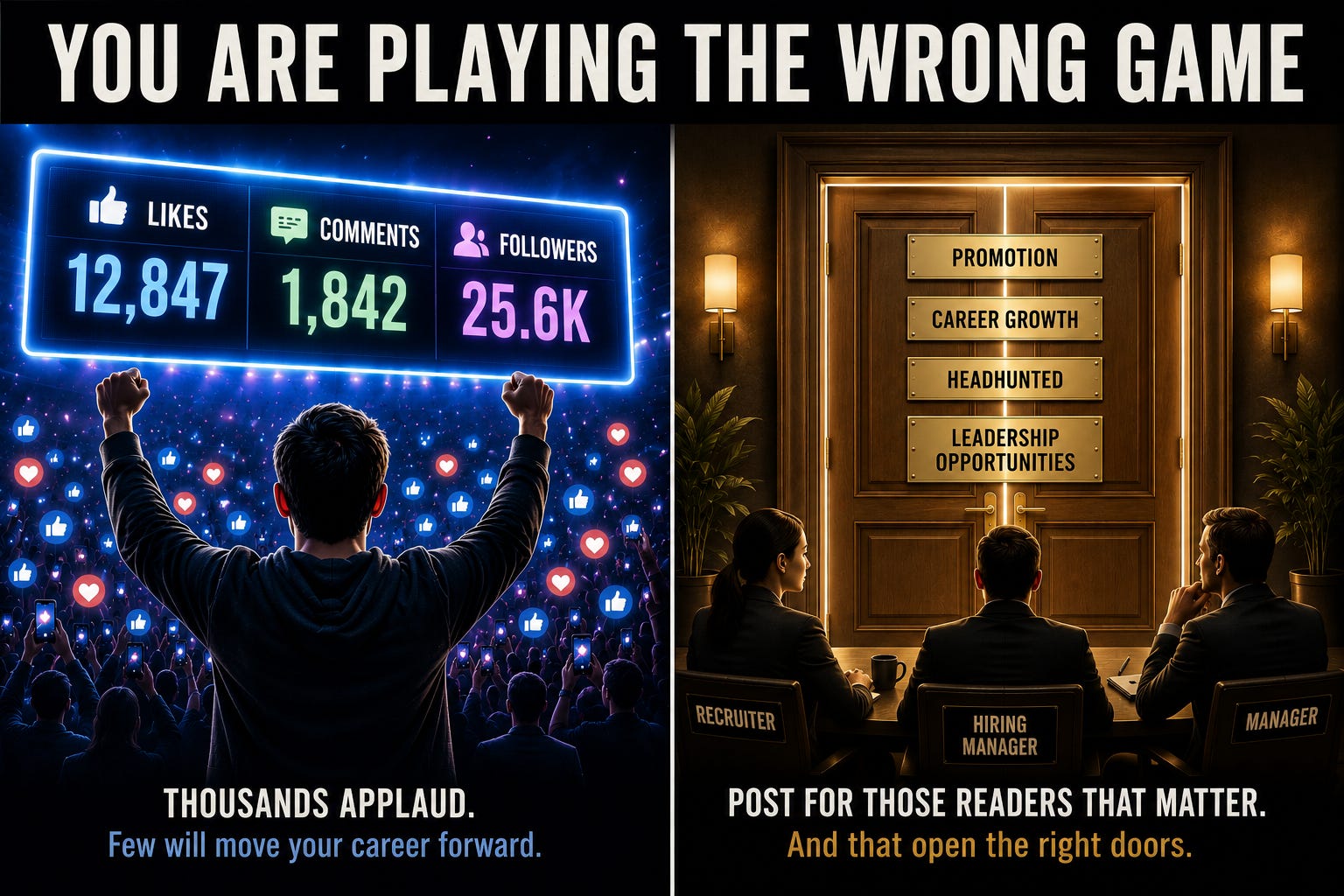
The Audience That Likes Is Not Hiring You
The single most expensive mistake on LinkedIn is treating engagement as the goal.
A clever post that gets 800 likes from strangers, none of whom will ever hire you, sponsor you, refer you, or sit in your calibration meeting, is a busy day with no compound. So basically, you spent the day performing for an audience that has no power over your career, while the seven people who do have power scrolled past you.
The actual metric is memory. Whether senior people in your industry, the recruiters who place at your level, the sponsors who can move you into rooms you are not in, and the future hiring managers who will look you up before reading your resume, remember a single specific thing about you when your name comes up.
Memory is rare and compounds. Likes are common and evaporate.
Three Rules That Matter
1. Differentiation is the need
If you sound like every other professional in your category, the algorithm has no reason to surface you. The human reader has no reason to remember you. Sounding like everyone else is the most expensive thing you can do on LinkedIn, and most people pay that price without noticing.
2. Focus is the discipline
Pick three things you will be known for. Refuse the rest. The urge to post on everything kills your specificity.
3. Consistency is the contract
The algorithm has to be fed. A banger on Monday and silence for a month leaves you invisible. Two consistent posts a week beat one excellent post a month, every time. A spike is not a strategy.
Differentiation. Focus. Consistency. In that order. Lock them.
The One Filter to Deploy
Every post should pass one filter: Would this only sound right coming from me?
If the answer is no, do not post it. The post is borrowed. The post is decorative. The post adds to the noise the algorithm now penalizes. If the answer is yes, write it. That single filter kills most of what you were planning to post and saves the time for what actually moves you.
Ten Posts Worth Writing
Rotate through these instead of recycling the toxic-boss carousel one more time.
The credential post. Who you are, what you have shipped, and the kind of work you take on. Not your title. Your actual standing is plainly stated. It is earned and true.
The contrarian take. The consensus in your industry is wrong about one specific thing. Argue against the room.
The specific decision, with the trade-off attached. A real call you made this week. The two options. The price you paid for the one you chose.
The mistake you made, and what it cost. Dollars, time, or trust. Most professionals refuse to publish this. The rarity is the asset.
The framework you actually use. Named and drawn, not borrowed. The two-by-two you scribble. The decision tree you run in your head. The vocabulary travels with your name attached.
The teardown. A launch, a pitch, a campaign someone ran this week. Your edits. Specifically.
The unresolved question. Not the rhetorical “what do you think?” line. The real one. Let the reader see your mind moving.
Who do you build for? And louder, who you do not. Naming the exclusion is what makes the inclusion legible. A profile for everyone is for no one.
The receipt. A screenshot. A number. A before and after. Proof of work, not a description of it.
The invitation. What you actually want from the reader, said plainly. No “thoughts?” No begging.
Differentiate Based on Your Years of Experience
The three rules hold across both. The post mix and the goal shift.
In your first two years of work, LinkedIn’s job is visibility and signal. Recruiters and senior people in your field need to be able to find you and read you quickly. Lean on the credential post, the framework you are starting to build, the contrarian take that signals an actual mind, and the unresolved question that shows you are reading the room around you. Skip the receipt and the invitation for now. You have not yet built the standing to write them, and writing them early reads as performance. Your job right now is to be findable and worth a second look once you are found.
In your next eight years, the job changes. You are no longer trying to be seen. You are trying to be named in rooms you are not in. The decision-with-trade-off, refined framework, teardown, mistake-with-cost, and who-I-build-for posts do most of the work. The reader you want is no longer the recruiter. It is the senior person in your industry who decides whether you get the larger project, the bigger role, or the promotion. Write for them.
Same three rules. Two different post mixes. Same writer, moving up the curve.
What Almost Everyone Gets Wrong
The “thoughts?” tag at the end of every post is begging. Delete it. A good post earns engagement without asking for it.
The “what do you think?” framing lowers conversion. Statements convert. Questions do not. Find every question mark in your last ten posts and convert half of them into statements. Read the difference out loud.
The worst trap is writing for other LinkedIn-strategy accounts. The signal that you have fallen into it is when your comments are all from creators paying creator compliments. Wrong audience entirely.
The fix for all three. Write like you are already the person the reader should follow. Do not perform the climb. Stand at the top of it.
The Asset Underneath the Profile
Your career is an asset. The LinkedIn profile is the outer signal of that asset. Most of the work that makes the profile worth following is the inner engineering nobody sees on the feed.
You can make LinkedIn ‘the work.’ In that version, you produce a feed. Daily content. The numbers move a little. The career does not.
Or you can make LinkedIn the surface of work you are actually doing somewhere else. The harder work. The unglamorous work. The work nobody is filming. In that version, you post less. You post sharper. And ten years in, you look up and notice that the people who outposted you by a factor of five have not gone anywhere, while you are sitting in rooms they cannot get into.
That’s the trade-off. You’re not late in posting; you’re selecting which game to focus on. In practice, this is how you RISEUP@work.
Dr. Deepak Bhootra spent 34 years in leadership roles and 14 years as an ICF-certified coach, touching the lives of 1,500 people. Those learnings led him to found RISEUP@work, a career operating system that travels with professionals across the full arc of their working life, organized around three developmental stages (Launch, Foundation, Dividend) and built on a foundation we call Human at the Core. RISEUP@work is raising capital now, ahead of a revamped platform build aiming for a July launch, with a minimum investment of $100 to keep participation broad. Invest at wefunder.com/riseupatwork.