

You are tired, but you cannot quite tell what kind of tired it is.
There are weeks when you feel stretched thin and still somehow alive, as though all the effort is building toward something worth having, and there are other weeks when the very same hours leave you hollow in a way that a full night of sleep does not touch.
The workload barely changes, yet the experience is completely different, and most of us are never taught to tell the two apart, even though they call for opposite responses. So before you reach for the word burnout, which has become the label we attach to almost any hard week, it is worth slowing down and checking whether that is really what you are living through.
Understand what you are measuring against
We tend to treat all stress as something to avoid, but research has never supported that. The endocrinologist Hans Selye spent his career distinguishing between distress, the corrosive kind that wears us down, and eustress, the beneficial kind that stretches and strengthens us (Eustress). Eustress is the strain of a hard project you care about, or the discomfort of learning something just beyond your reach, and though it does not feel easy, it is genuinely good for you.
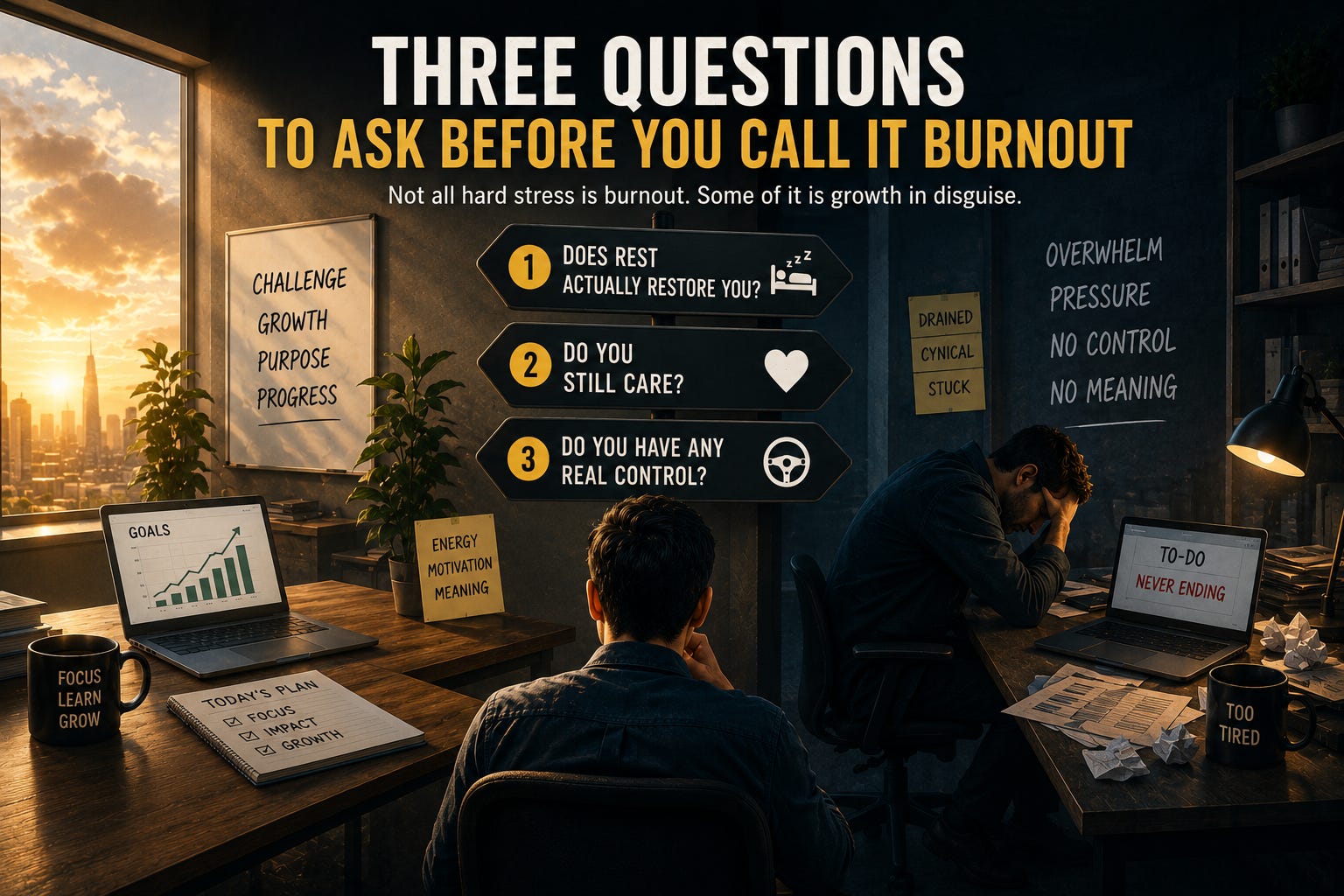
The difference between healthy stress and burnout is not how hard you are working. It is whether you recover, whether you have any control, and whether the work still means something to you.
That single distinction is what the three questions below are built to surface, because two people working equally hard can sit on opposite sides of it, one being strengthened by the pressure while the other is quietly worn down.
The three questions
Before you accept the burnout label, sit with these three honestly and pay close attention to what comes up. They are not a checklist to tick, but prompts to reflect on.
1. Does rest actually restore you?
After a real break, a weekend away or a proper night of sleep, do you come back with something in reserve, or does the heaviness settle back over you within an hour of logging on? If recovery still works, you are most likely being stretched rather than broken, but if rest changes nothing at all, that points toward the deep exhaustion that sits at the center of real burnout.
2. Do you still care?
Hard work that carries meaning will hurt and still feel worth it, so if you can find something in the difficulty that matters to you, that is a reassuring sign. It is when the caring gives way to cynicism, when you stop being pulled in by work that once held your attention, that the warning light genuinely comes on.
3. Do you have any real control?
A loss of agency over your workload, your pace, and your priorities is one of the strongest predictors of burnout there is, because hard work you have chosen sits very differently in the body than hard work imposed on you with no way out.
If your honest answers are that rest no longer helps, that you have stopped caring, and that you feel you have no control, you are probably not being stretched. You are burning out, and naming it plainly is the first step toward regaining your footing.
What the science actually calls burnout
Those three questions map closely onto how the World Health Organization defines the real thing. They describe burnout not as a rough week but as an occupational phenomenon that results from chronic workplace stress that has not been successfully managed, and they name three signs (WHO): a deep exhaustion that rest does not repair, a growing cynicism and distance from the work and the people in it, and a quiet decline in one’s sense of one’s own effectiveness. Set those beside a healthy stretch, and the contrast is clear: where eustress tends to leave you more engaged and more connected, burnout leaves you empty and detached.
What it tends to look like in real life
Burnout rarely arrives with any announcement, and it usually hides inside perfectly ordinary appearances, so it helps to recognize its disguises.
The high performer who went quiet. She used to bring ideas to every meeting, but now simply does the work well enough and says nothing, and because her output still looks fine on paper, nobody thinks to check on her, even though the silence itself is the symptom.
The Sunday that never lifts. He feels reasonably fine on Saturday, but watches a familiar weight descend by Sunday afternoon that does not lift until the week is nearly over, which is less about any single project than a constant low detachment that has become his baseline.
The one who cannot switch off. Always reachable and always slightly behind, answering messages late at night, not because anything is urgent, but because the body’s stress response has forgotten how to stand down.
None of these people is weak, and each is a capable professional whose relationship with their own work has quietly tipped from productive to depleting.
Why does this belong in a conversation about careers?
This is not a wellbeing footnote to your working life but something central to it, and the newest data makes that plain. In Deloitte’s 2026 survey, the single most common reason young professionals give for turning down leadership roles is stress and burnout, named by half of them, which means burnout is not only making people unhappy but actively narrowing their ambition and capping their careers before those careers have really begun.
The reframe worth holding onto is that your career is the one asset you carry across every job you will ever hold, and you cannot protect it by pushing harder. You protect it by learning to feel the difference between a healthy stretch and a slow burn, and by asking those three questions often enough that you notice the drift while it is still early.
Turning this into practice
Reading about burnout on its own changes very little, and it is reflecting on it that does the real work, so it helps to make that reflection concrete in three ways.
Check yourself on a schedule. Run the three questions once a month, with the same seriousness you would bring to reviewing your finances, rather than waiting for a crisis to force the issue.
Build recovery on purpose. Research points consistently to two experiences that restore us most, genuinely detaching from work and giving our attention to a skill that carries no professional stakes, both of which help turn hard effort back into the healthy kind.
Do not do it alone. Burnout deepens in isolation and eases considerably when you can admit to someone who understands that you are struggling, which is exactly why community and mentorship sit at the center of what we are building at RISEUP@work. Someone who reflects alongside others and has a mentor close enough to notice the drift before they do tends to catch burnout before it becomes a full collapse, with only a small correction.
Agency over anxiety is not a phrase we use for effect, but the practical difference between tending a fire and being consumed by one.
The honest close
Stress itself was never the problem, and a career worth having will stretch you in ways that are genuinely good for you. The problem is the particular kind of stress that never ends, that you cannot steer, and that has lost its meaning, and the whole skill lies in feeling that difference early and keeping people close enough to tell you the truth about what they see in you.
Guard that fire carefully, because it is the one that has to last you a whole career.
This is a reflective piece and not medical advice. If you are struggling, please reach out to a qualified professional or to someone you trust.
Dr. Deepak Bhootra is the founder of RISEUP@work, a career community for the first decade of work. He is the author of four books and has coached professionals across four countries. RISEUP@work is currently welcoming community investors on Wefunder at wefunder.com/riseupatwork.
Subscribe for more like this: https://riseupatwork.substack.com/subscribe