


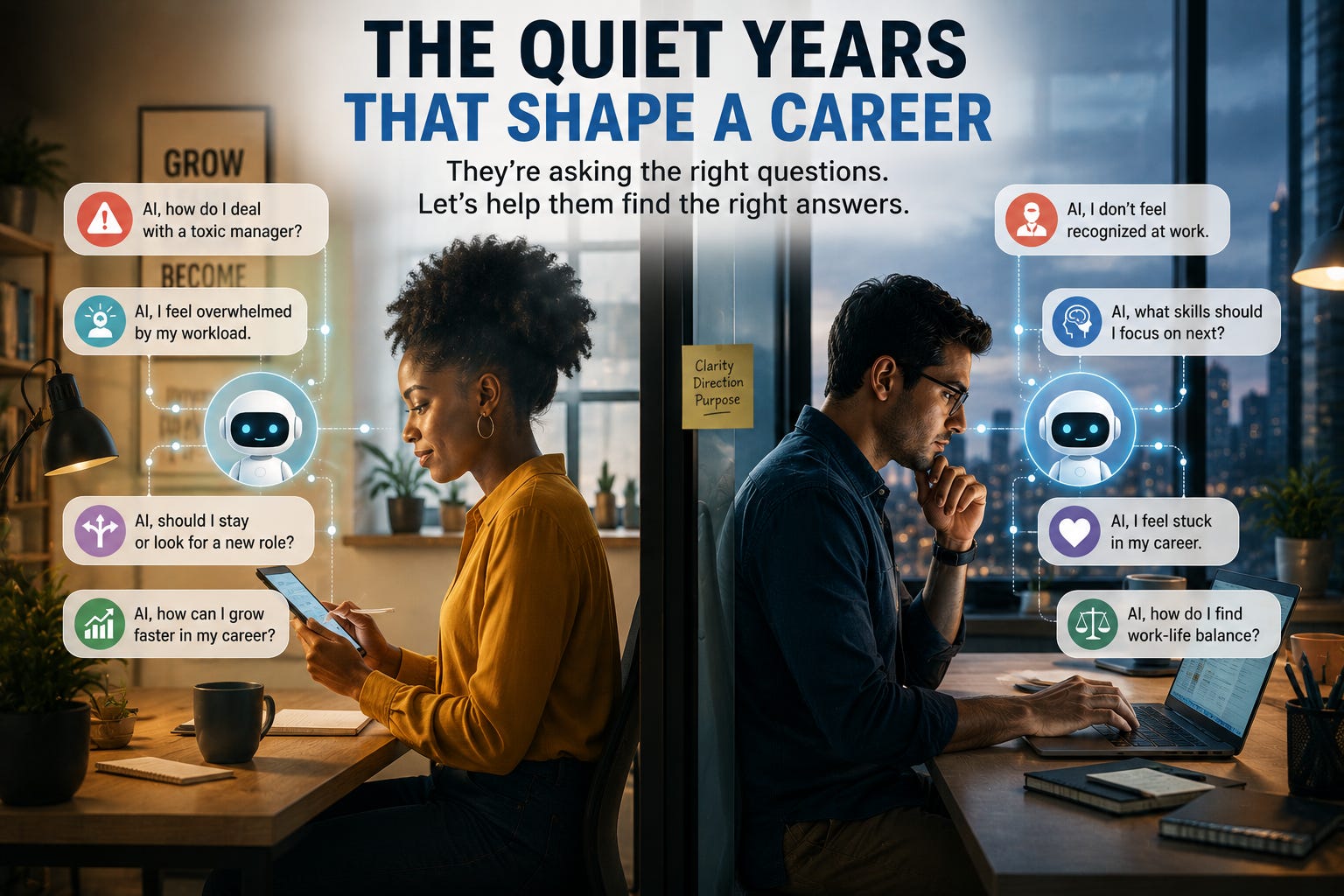
Young professionals now have a career coach. It is their phone.
In Deloitte’s 2026 Gen Z and Millennial Survey, which polled more than 22,000 people across 44 countries, 72% of Gen Z said they now use AI to seek career advice, and 67% use it to cope with work-related stress. Three-quarters use it in their daily work, up from just over half a year earlier (Deloitte 2026 Gen Z and Millennial Survey).
Read that as a practitioner, not a headline. When someone at the start of their career feels lost about who to become, they are not turning first to a manager or a mentor. They are turning to a chatbot. And they are asking it not for facts, but for direction.
I do not read that as a generation in trouble. Deloitte calls this a coming-of-age story, not of delay, but of discernment, and I agree. A whole cohort is telling us, through their behavior, that the early years are disorienting, that they are hungry for a guide, and that no one handed them a good one. That is worth understanding before we judge it.
What they are actually reaching for
The same survey shows these workers now judge progress by the skills they are building, not the titles they collect. Only a quarter are chasing fast promotions. About one in five would even take a sideways move or a more junior role if it gave them better experience.
So this is not a lazy generation avoiding the hard climb. These are people trying to build something solid inside themselves. They are looking for self-knowledge. They just have nowhere reliable to find it.
And their timing is right. The science shows that the early twenties are exactly when a person is still deciding who they are, which makes this the best possible moment to do that inner work.
A self that is still forming
Psychologists describe the years from roughly 18 to the late 20s as their own life stage. Jeffrey Arnett called it emerging adulthood, and its defining feature is identity exploration, the period when people work out their capabilities, their limits, their values, and where they fit (Noba Project).
The biology agrees. The prefrontal cortex, which governs judgment and planning, continues to mature into the mid-20s, well after a person starts working (Lurie Children’s).
So when a young worker reaches for a guide, they are not being weak. They are responding, correctly, to the fact that they are still being formed. The instinct is sound. The question is what they form themselves around.
Whose pattern do you absorb?
Here is where it gets risky. When we are new and unsure, we take our cues from whoever is nearest and most confident.
Monica Higgins at Harvard studied how this plays out at work and called it career imprinting. A first serious employer leaves a lasting mark on four things: capabilities, connections, confidence, and the way a person thinks about how work operates. She notes plainly that people early in their careers are more impressionable and carry no strong prior pattern to weigh a new one against (Harvard Business School).
Now put that beside the Deloitte number. A generation at its most impressionable, reaching for a guide, and increasingly that guide is a tool that reflects back the most common pattern rather than the right one for them. A borrowed self is easy to absorb. It is much harder to notice you have absorbed it.
The thing the tool cannot give you
There is a deeper gap under all of this, and it is the most humbling finding I know.
Tasha Eurich’s research found that while about ninety-five percent of people believe they are self-aware, only ten to fifteen percent actually are. She also describes two separate kinds of self-awareness that do not travel together: an internal sense of your own values, and an external sense of how others see you (Forbes on Eurich).
This is what a chatbot cannot hand you. It can produce a fluent answer in seconds. It cannot give you an honest read on who you are, because that has to be built slowly, often with the help of someone willing to tell you the truth. A young worker outsourcing direction to AI can get a confident answer, and still be no closer to knowing themselves.
The small practice that compounds
The encouraging part is that self-knowledge responds to something simple and proven.
In a field study by researchers from Harvard and HEC Paris, new employees who spent the last fifteen minutes of the day writing about what they had learned outperformed a group who kept working during those minutes by nearly 23% on a final assessment (Harvard Business School).
The lesson is practical. Structured reflection early in the learning curve compounds. Stepping back to look at yourself is not time taken from the work. In the formative years, it may be the most valuable time you spend, and it is the one thing the young workers scrolling for answers are least likely to be doing.
One way to respond
So here is the tension the 2026 data leaves us with. A generation knows it is still forming, wants a guide, and has reached for the nearest one. The instinct is right. The instrument is thin.
This is the direction we have chosen at RISEUP@work. Not a faster answer, but a structured way for people early in their careers to actually see themselves, through diagnostics, and a simple way to track what that clarity is worth over time, which we call a Return on Clarity Index. By longitudinal, a word we lean on, we mean something a person returns to as they change, rather than a one-time verdict.
We have not solved it. We are saying the newest data points somewhere specific, and a chatbot is not the whole answer. Reasonable people could read the same numbers and build differently. We would welcome that conversation.
What I hope you take from this
The young workers reaching for AI are not the story. What they are reaching for is.
They are telling us the early years are formative, that they know it, and that they want help making sense of themselves before the pattern sets. That is not a weakness. That is a generation asking a good question and being handed a shallow answer.
The self you build in these quiet years is easy to inherit by accident, and easier still to outsource. It is also, with a little more reflection and a better mirror, yours to choose.
Dr. Deepak Bhootra is the founder of RISEUP@work and writes on careers, clarity, and the first decade of work. He is the author of four books and has coached professionals across four countries. RISEUP@work is currently welcoming community investors on Wefunder at wefunder.com/riseupatwork.