

The pattern I keep seeing
I keep meeting professionals who cannot defend their own best work.
The deck appears polished, and the analysis is precise. The memo is more effective than anything produced three years prior. However, when a senior figure asks a probing question, there’s nothing beneath the surface. The model was created to look good; they delivered it, but the deeper understanding that normally develops during such work never developed.
Three decades in the corporate world. Fifteen years of coaching/mentoring, and this is the newest version of a very old problem. The work looks finished long before the person is ready to own it. I wrote once about the cleanest emails I had read in twenty years, and how the writing kept getting better while the person behind it did not always show up when the conversation turned specific. This is that one level deeper.
A good idea worth carrying forward
Chris Chambers put words to part of this in a piece titled: Owning Outcomes in an AI World. Do read it.
His argument illustrates how accountability has shifted since the Industrial Revolution, which moved responsibility onto the factory floor where an inspector approved the cloth before shipping. Similarly, AI is revolutionizing knowledge work by automating analysis, yet it’s unclear who now reviews the AI-generated output. Unlike a witness in a court, a machine cannot stand trial. Human oversight remains essential because the contract still bears a human signature. Therefore, someone must review and confidently endorse the machine’s work, a skill that, as Chris points out, is increasingly rare compared to the ability to produce the work initially.
The idea is right, and it travels further than the office. Carry it into a whole career, and it changes how you should spend your first ten years of work.
What the evidence adds
The research is starting to catch up to the worry.
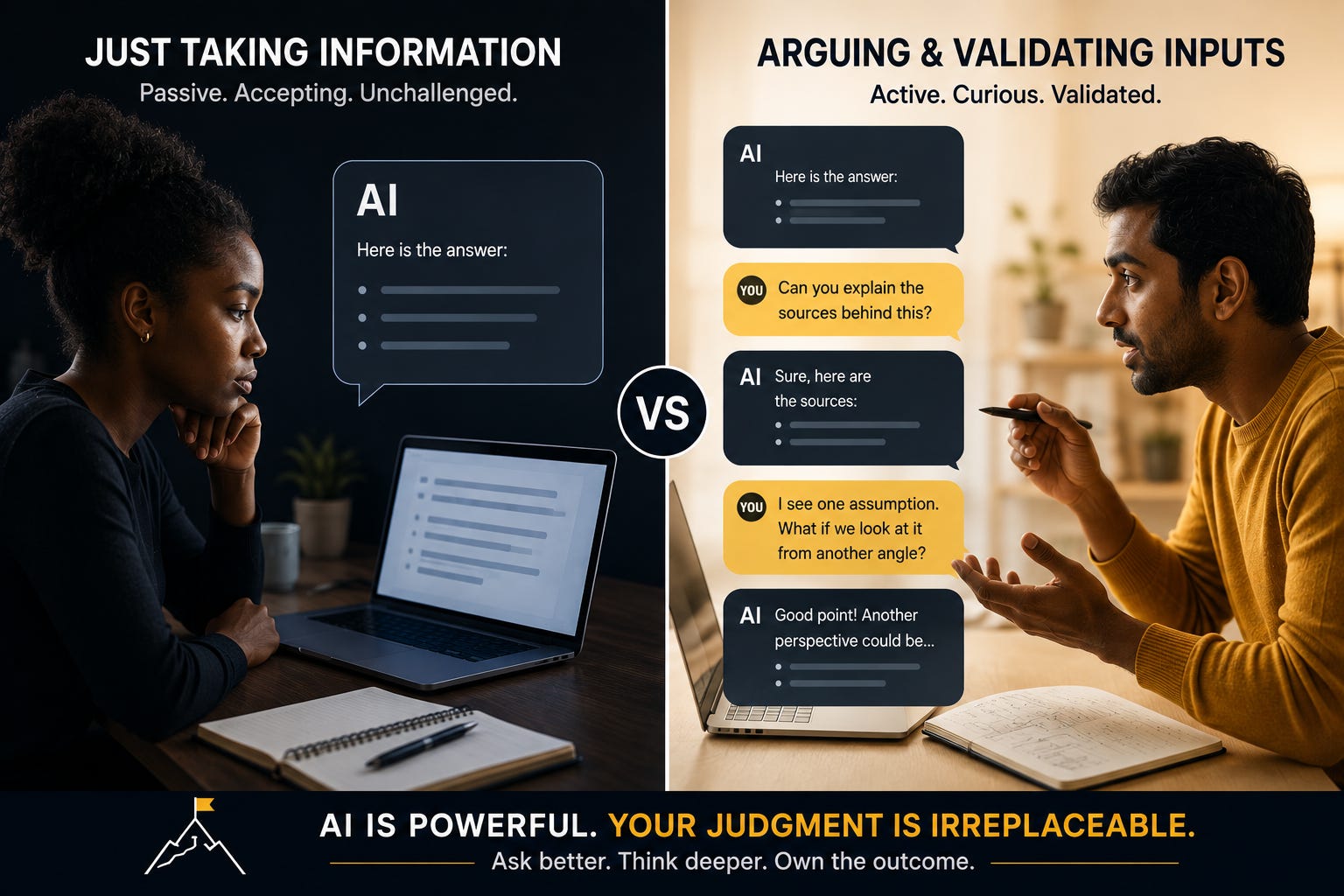
A survey of 666 adults found that heavier AI users scored lower on critical thinking, and the effect ran almost entirely through cognitive offloading, the quiet habit of handing the thinking to the tool rather than doing it beside the tool (Gerlich, 2025). The youngest group leaned on AI the most and scored the lowest, and that group is standing at the front door of their careers. A second study of 319 knowledge workers found that the more someone trusted the AI, the less they questioned what it handed back (Lee and colleagues, 2025).
So the tool is most tempting at the exact moment when a person has the least experience with it. That is when the damage compounds instead of showing up.
Where a career is actually built
Here is where I take Chris’s idea somewhere he did not. The ability to stand behind your work is not a switch you flip once you reach a senior role. It was built years earlier through a specific mechanism, and AI is quietly interfering with that mechanism.
The mechanism is apprenticeship. Matthew Beane studied surgical trainees learning robotic surgery and found that better technology pushed trainees out of the actual doing, so the hands-on struggle that used to build skill simply did not happen, and only a minority reached real competence (Beane, 2019). Different technology, same shape as AI at a desk. When the tool does the hard part, the learning that used to live inside it goes missing.
And the hard part is where judgment forms. One researcher studying the broken rungs of the career ladder put it cleanly. Judgment is the product of thousands of supervised decisions accumulated over years of practice, forged in real-time experience that is rarely written down (Zhang, 2026). You cannot download that. You earn it by making calls, being wrong, getting corrected, and doing it again, early and often.
Skip that stretch, and the failure is not abstract. In preregistered experiments with more than 1,300 people, when the AI was wrong, the humans following it dropped below the accuracy they had shown with no help at all. The researchers named it cognitive surrender (Shaw and Nave, 2026). A person who never built the judgment cannot catch the machine on the day it fails, and the machine will fail.
At RISEUP@work we call this window the Launch Stage, from Year minus 4 to Year plus 2, and the Foundation Stage, from Year plus 2 to Year plus 10. It is the first decade of your working life, and it is when the residue of judgment forms or it quietly does not.
The market is already pricing this
None of this is a reason to avoid AI, and the job market is making that clear.
PwC studied more than a billion job ads and found that entry roles most exposed to AI are now seven times more likely to demand skills that used to be reserved for senior people, and the new tasks appearing in those roles are far more likely to call for judgment, creativity, and the ability to weigh a messy situation (PwC, 2026). The lower rungs are being lifted higher. The people who get a foot in the door are the ones who can already do the judging, not just the producing.
How to use AI without losing your edge
So, what’s on your Monday agenda? Four disciplines, none requiring you to close the tool.
1. Do the first pass of the thinking yourself, even a rough one.
Write the ugly version of the analysis before you open the model, so that when the polished version comes back you have something of your own to hold it against. The sequence is the whole trick. When the thinking comes first and the drafting second, the judgment stays in your hands even after the typing leaves them.
2. Run a defend test before you send anything.
Find the one decision inside the work that you cannot yet explain out loud, and close that gap. Ask what the model assumed. Ask where it could be wrong. Ask what you would say if the sharpest person in the room pushed on that exact line. If you have no answer, you are holding the cloth without being able to stamp it.
3. Keep a short record of the calls you make and why you made them.
Two lines after any real decision. What you chose, and what tipped you. A scatter of choices becomes a track record you can learn from, and that record is the raw material judgment is built out of. It is also, not by accident, what a good career journal is for.
4. Watch your own signature.
On every task, notice whether you are still doing the thinking or the tool has taken it over while you sit and approve. The professionals who stay sharp always know, task by task, which of those two is happening to them. That awareness is the edge. Everything else is technique.
The part that stays yours
Step back, and the through-line is hard to miss. Your role is rentable. The title can be reassigned tomorrow, and the tasks inside it are the first things a capable model absorbs. What does not transfer to anyone else is the judgment you built while doing the work.
The career is the asset. AI just raised the price of the one part of you that can own an outcome.
That is what RISEUP@work is built to protect. The diagnostics make you reflect before you decide, rather than after. The milestones force a real call each quarter rather than one more deliverable. A coach stays in the loop, which is what keeps the tool sharpening your thinking instead of standing in for it. It is the same thread I followed in the piece on running your career as a journey rather than chasing a finish line, because judgment, much like purpose, is something you grow into by living it.
Chris was right that someone still has to sign off on the work. The quieter truth is that the someone who can actually do it is built over time, and the building happens early. Spend your first decade becoming the person whose name means something on the page. That is the edge no model can hand you, and it is the one worth having.
Dr. Deepak Bhootra is the Founder and CEO of RISEUP@work. He spent three decades as a senior leader within Fortune 100 companies across four countries, earned a doctorate studying what drives professional satisfaction and commitment, and has spent 15 years as an ICF-certified coach across more than 1,500 coaching relationships. RISEUP@work turns that experience into a career progression platform built for the growth that begins after you are hired. It is live and welcoming early adopters at riseupatwork.com.
Ready to build the edge no model can hand you? Join RISEUP@work and start building.