

The Paper, and the Mood Around It
Two headlines ran this week over the same Federal Reserve Bank of New York analysis. Bloomberg’s read: “Remote Work Impacts College Graduates Finding Jobs, Fed Study Says.” CNBC’s read: “Remote work is worsening youth unemployment.” Same data, two very different stories, and the second one is the one being weaponized.
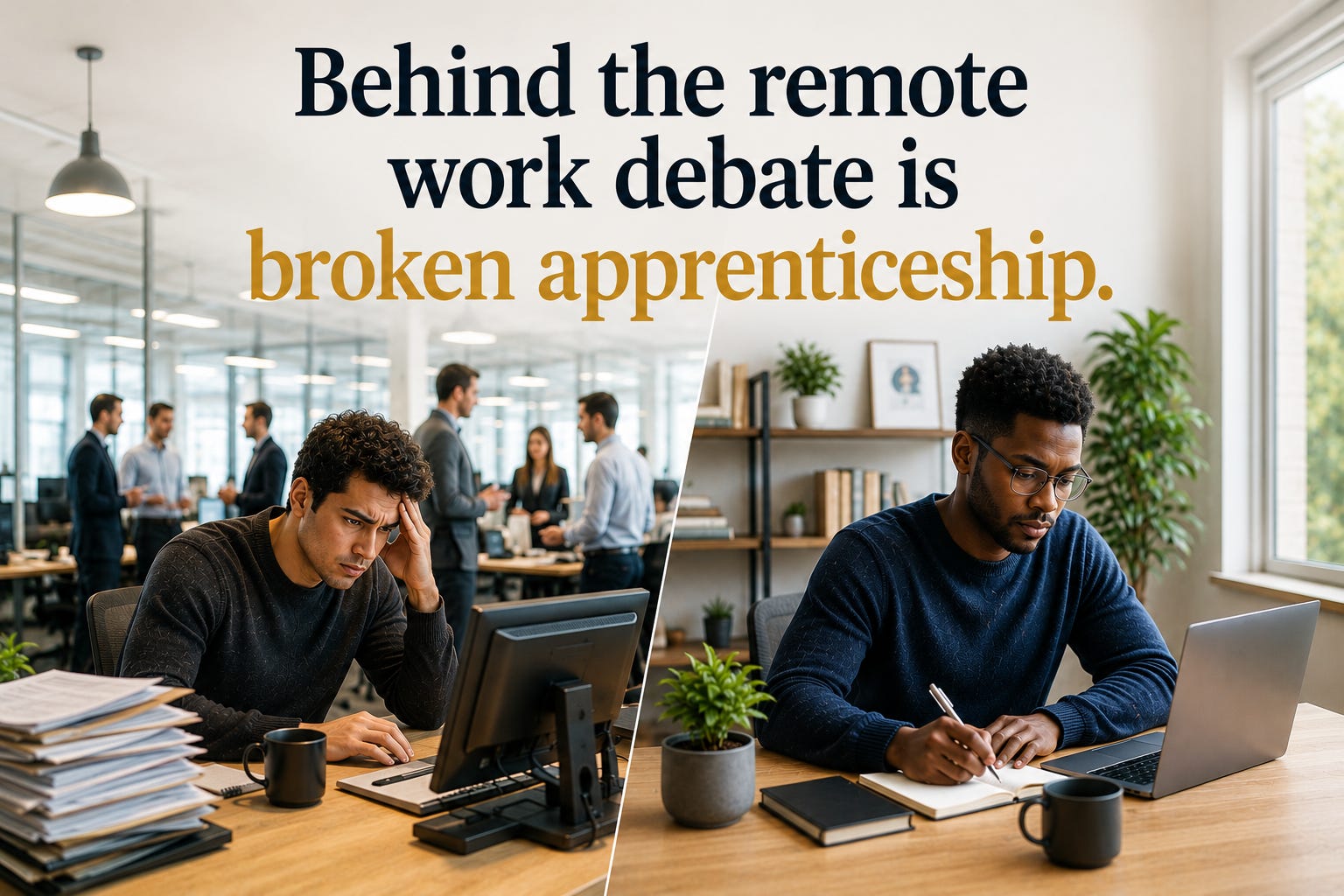
The paper itself examines the rise in unemployment among recent college graduates and suggests that a significant share of the increase, as much as 64 percent in its estimate, can be attributed to remote work. The proposed mechanism is straightforward. Employers, the argument runs, are reluctant to hire inexperienced people into distributed teams because training and onboarding are harder when nobody shares a building.
The research is careful, even where the reading of it has not been. By the time the headline reached LinkedIn, the framing was already a moral indictment. Graduates are unemployed because they refuse to come to the office. The kids did this to themselves.
I am building RISEUP for exactly the cohort being scapegoated, and I have to say it plainly. This is one of the most dishonest framings of the year.
The Bait and Switch
Watch where the moral weight just shifted.
For the last two years, the public conversation has watched Fortune 100 companies cut tens of thousands of professionals in the name of AI. We watched Cloudflare’s CEO defend a 22 percent reduction as the company’s future. We watched layoffs at Meta, Microsoft, Coinbase, Cisco, and many others, all framed as the inevitable cost of a technological transition. Almost nobody on the executive side of that conversation argued that the workers’ cut was the problem. The story was structural. The workers were collateral.
Now the script flips. The same voices that did not object to a generation of professionals being cut for AI are asking us to think badly of graduates who do not want to spend their first paycheck on a commute. The structural framing that protected executives is suddenly unavailable to 23-year-olds. What was a strategic decision when the company did it becomes a moral failing when the worker does it.
That is the bait-and-switch, and it should not be allowed to pass quietly. Anyone who watched a decade of layoffs framed as inevitable and now frames graduate behavior as a character flaw is engaging in a particularly cynical move.
The Two Variables Everyone Is Ignoring
The reason the conversation is going off the rails is that two enormous variables hit the labor market back-to-back, and almost nobody is honestly factoring them into the analysis.
The first is COVID. For two years, the entire apprenticeship infrastructure of the modern economy was interrupted. The watercooler conversations, the in-person mentorship, the casual proximity that allowed junior people to absorb how decisions were actually made, all of it paused. Companies improvised, and most of the improvisation was triage rather than deliberate redesign. The pipeline that produced experienced professionals did not adapt. It limped.
The second is AI. Before the labor market had time to rebuild that pipeline, AI arrived and began doing exactly the codified entry-level work that the pipeline used to give the young as a learning vehicle. The 16 percent drop in entry-level headcount for 22- to 25-year-olds in the most AI-exposed occupations, documented by the Stanford Digital Economy Lab, is not a story about remote work. It is a story about a learning pipeline that was already weakened by COVID, only to be hit by the next wave before it could recover.
Factor those two variables in, honestly, and the picture clarifies. The remote work signal in the NY Fed paper is real, and it is the smaller story. The economy’s apprenticeship infrastructure has been disrupted twice in five years, and we have never rebuilt it. I wrote the long version of this argument in The Apprenticeship Bridge Is Burning.
What Is Actually Broken
Here is the harder truth that most of the conversation is avoiding.
Companies have quietly stopped investing in developing the people they hire. The shift did not start with COVID, nor with AI. It started two decades ago when the discipline of buying talent began to replace the discipline of building it. Hire someone who is already productive. Avoid the cost of teaching them. Outsource the training to the previous employer, or to a credentialing system, or to the person themselves.
Remote work did not cause that shift; it exposed it. When an organization can only train someone if they are physically in the same room, it is actually saying it never had an intentional development system. The office was the system, and the moment you removed the proximity, the absence of that system became visible.
That is the mechanism the NY Fed paper is identifying. Read carefully, it is an indictment of organizational design, not of remote work.
The Pattern Underneath the Pattern
This is not a one-off story. The structure is failing in three places at once, and I have written about each.
In AI Is a Threat to Your Job. But a Bigger Threat to Your Promotion, I argued, is that the climb into management is now structurally risky because management is mostly measurement, and measurement is exactly what AI now does best. The middle of the ladder is collapsing. In The Apprenticeship Bridge Is Burning, I argued that the bottom rung is disappearing because the codified work entry-level jobs used to do is what AI does best. In The Corporate Deal Is Dead, I argued that the implicit contract that held the ladder together has quietly disappeared.
Anyone pointing at remote work as the singular cause is either missing the bigger story or telling a more convenient one.
The Loyalty Era Is Over
There is one more piece of intellectual honesty owed to this conversation. The loyal-employee era is over, and the people pretending otherwise know it.
Companies want immediate productivity. They no longer build the path that once produced loyalty in return. Asking employees to invest in the building when the building stopped investing in them years ago is asking them to participate in their own slow decline. The professionals walking into work today are no less committed; they are more clear-eyed. They have watched the structural decision-making happen on the other side of the table. They are responding rationally.
The future belongs to companies that can develop people on purpose, regardless of where they sit. Blaming remote work is the easy answer. Naming the absence of a learning system is harder, and it is the one that actually moves us forward.
If you are in a career, this conversation is being used against you; do not absorb the misdiagnosis. The system around you changed. The source of your value did not. It is still you. Build it on purpose.
Dr. Deepak Bhootra spent 34 years in leadership roles and 14 years as an ICF-certified coach, touching the lives of 1,500 people. Those learnings led him to found RISEUP, a career operating system that accompanies professionals throughout the full arc of their working lives, organized into three stages: Launch, Foundation, and Dividend. RISEUP is raising capital now, ahead of a revamped platform build aiming for a July launch, with a minimum investment of $100 to keep participation broad. Invest at wefunder.com/riseupatwork.
Sources
Remote Work Leaves Younger Workers Sidelined, Liberty Street Economics, Federal Reserve Bank of New York, June 2026 (the primary source).
Remote work is worsening youth unemployment: New York Fed, CNBC, June 1, 2026.
Remote Work Impacts College Graduates Finding Jobs, Fed Study Says, Bloomberg, June 1, 2026.
Stanford Digital Economy Lab, “Canaries in the Coal Mine? Six Facts about the Recent Employment Effects of Artificial Intelligence.”