


What the Data Just Told Us
Two pieces landed in the last week that point to the same thing.
David Rotman at MIT Technology Review did the calm work of looking at the labor market data. The honest finding is that AI is not, in aggregate, devouring white-collar work. Only one in five US companies reports using AI in any function. Unemployment for the most AI-exposed occupations is actually lower than for less-exposed ones, and wages in those sectors are rising. Most readers will quote that and exhale.
Buried in the same piece is the Stanford Digital Economy Lab’s sharper finding. For 22 to 25-year-olds in the most AI-exposed occupations, including software development and customer service, the entry-level headcount has fallen by 16 percent. For older workers in the same occupations, headcount grew. The “earn-while-you-learn” model, where young graduates do tasks they will eventually master and quietly absorb tacit experience along the way, “might finally be broken, at least for some occupations.”
Conor Grennan at AI Mindset goes after the framing of the same conversation. His argument is that AI behaves less like a technology and more like a participant, which is why the historical playbooks, Jevons paradox, lump of labor, “tech always makes new jobs,” no longer fit. Every previous wave moved humans up the cognitive ladder when machines took over the doing. There is now nowhere obvious to move up to, because AI is doing the cognitive lifting alongside us. The escape valve is partially closed for the first time in a century.
Read together, the two pieces narrate one quiet story. The real disruption is happening one rung lower than the layoff conversation, in the disappearance of the rung the young used to step on.
What Is Actually Burning
For a hundred years, careers were built on a quiet pipeline. You graduated, took an entry-level job, did codified work, and absorbed everything the textbook could not teach you along the way. How decisions actually get made. How politics actually move. How a senior colleague actually thinks. That accumulated wisdom has a name. Tacit knowledge.
Tacit knowledge is the moat. It is what older workers in the MIT data are pricing into their salaries right now. It cannot be written down without losing what makes it valuable, which is why no large language model can do it yet. The professional with thirty years of experience is the one the market is still hiring up.
But tacit knowledge was never built by the textbook. It was built through apprenticeship, the years spent doing the codified work in the room with people who knew what could not be written down. That is what is burning.
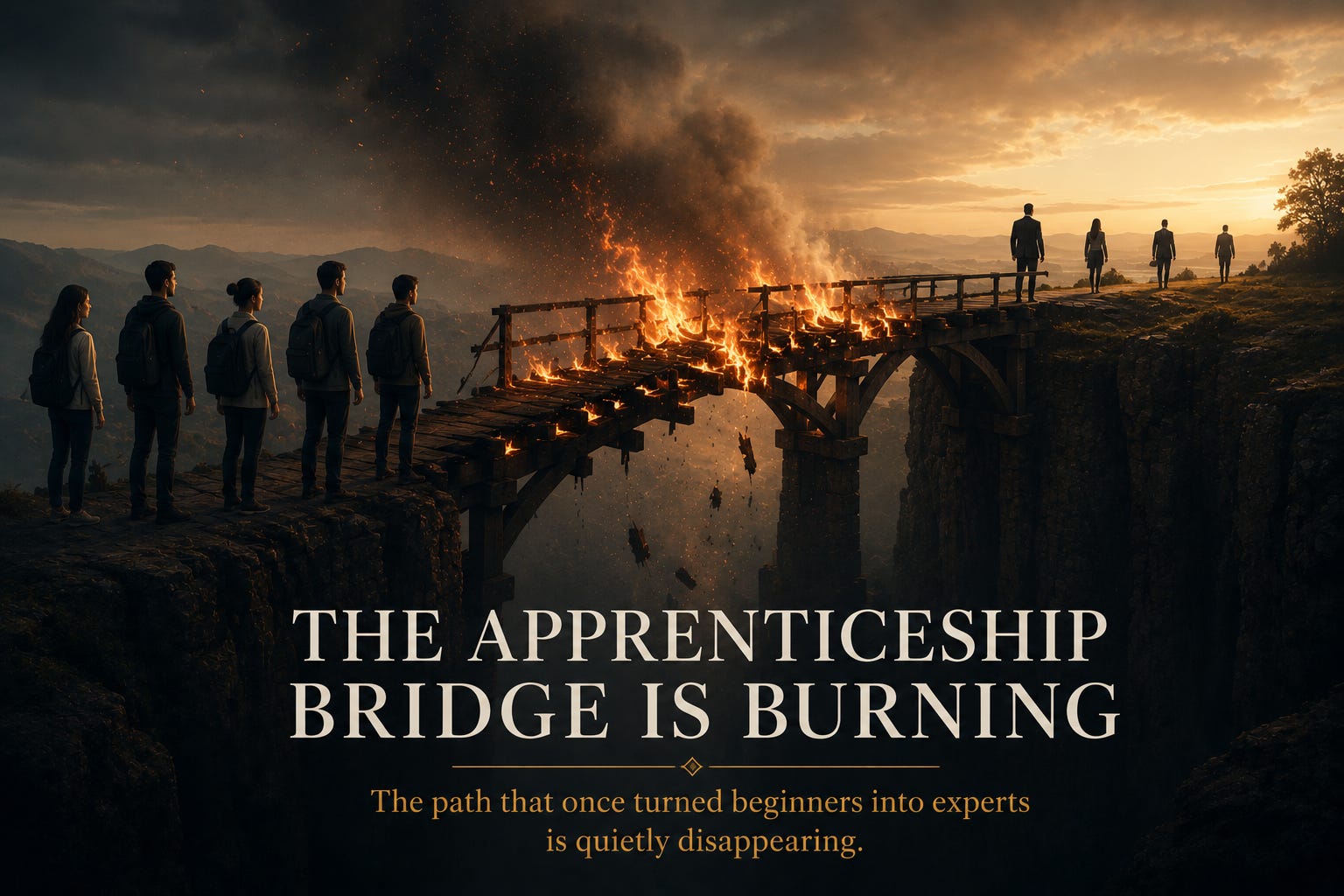
The codified work is exactly what AI does best, and the companies that used to absorb new graduates into entry-level seats are increasingly not doing it. The earn-while-you-learn model only works if someone is willing to pay you while you are learning. In the AI-exposed lanes, fewer companies are.
The paradox older workers will live through and not feel for a while is this. The single most valuable thing in the new economy has lost the pipeline that once produced it.
I wrote earlier this month about a different rung of the same ladder, the climb into management, becoming structurally risky because measurement is precisely the work AI now does. Put the two together. The bottom of the ladder is disappearing, and the middle is becoming dangerous. The ladder, as a career planning instrument, is not what it used to be.
Why the Old Advice Falls Short
The standard responses on offer are thin.
“Learn AI” is true but insufficient. The bar to use a frontier model is laughably low. What is hard is the judgment around its output, and judgment has never been a course you can take.
“Pick the AI-adjacent major” is partially right and races a moving target. By the time the syllabus is set, the field has shifted.
“Just get experience” is the cruel one. It pretends the entry-level door is still open, even though the data show it is closing in the lanes that matter most.
What is missing is Conor Grennan’s deeper point. This is an organizational and personal-system problem, not an individual skills one. Companies that win will rewire how their people work. Professionals who win will rewire how they build the asset, because waiting for the company to do it on a timeline you can actually use is a bet you cannot afford to make.
The Move Underneath the Headlines
If the apprenticeship pipeline can no longer be relied on to produce tacit knowledge, the move shifts from passive to active. You stop waiting for the role to teach you what it used to teach you, and start building it on purpose, outside the collapsing pipeline.
Three things move.
Intent. The tacit knowledge older workers built almost by accident now has to be built deliberately. Treat every assignment, every conversation, every decision as a chance to log a real rep, and seek out the reps where judgment, taste, and accountability are on the line.
The system around the work. What needs to change is not the tool but the operating model around it. A career that compounds in this era requires a personal operating system, with a continuous diagnostic on where you stand, where you are pointed, and what is in your way, paired with deliberate reps that build the inner engineering AI cannot do for you.
The company you keep. Tacit knowledge is transmitted human to human, or it is not transmitted at all. The professionals who break through will surround themselves with a peer group and a small set of senior voices who can name what they cannot yet see. That structure used to come built into the entry-level seat. It now has to be constructed on purpose.
What We Are Building
RISEUP@work exists for the professional standing on a rung that is quietly disappearing. It is the operating system for building career net worth across the full arc, organized around three stages: Launch, Foundation, and Dividend. At the heart of it is a continuous diagnostic of where you stand, where you are pointed, and what is in your way, paired with the structure and the people who used to come, built into the entry-level seat.
The response to all of this is neither panic nor another course. It is the deliberate construction of the inner engineering that the apprenticeship used to build, almost as a side effect.
You still own the source of your value. The world has changed the bridge. The asset is still you. Build it on purpose.
Dr. Deepak Bhootra spent 34 years in leadership roles and 14 years as an ICF-certified coach, touching the lives of 1,500 people. Those learnings led him to found RISEUP@work, a career operating system that accompanies professionals throughout the full arc of their working lives, organized into three stages: Launch, Foundation, and Dividend. RISEUP@work is raising capital now, ahead of a revamped platform build aiming for a July launch, with a minimum investment of $100 to keep participation broad. Invest at wefunder.com/riseupatwork.
Sources and Acknowledgments
With thanks to David Rotman at MIT Technology Review and to Conor Grennan, whose AI Mindset newsletter is consistently one of the most useful reads on how AI is reshaping the way we work. Both pieces are worth reading in full.
A reality check on the AI jobs hysteria, David Rotman, MIT Technology Review, May 26, 2026.
The AI Job Apocalypse Debate is Wildly Flawed, Conor Grennan, AI Mindset, May 29, 2026.
Canaries in the Coal Mine? Six Facts about the Recent Employment Effects of Artificial Intelligence, Stanford Digital Economy Lab.