


Where This Started
Three weeks disappeared before I noticed any of it.
Everything seemed fine externally. I met all deadlines, and my calendar remained as busy as usual. Each morning, I chose the task I knew how to handle and postponed the tougher ones to the next day, a pattern I kept accepting. By week four, the tough task had become urgent, costing me a weekend I had promised to someone else. In an office, this situation wouldn't last three weeks; someone would pass by and ask about it early on. Working alone so far from others, no one passing by ever questioned anything.
This made me realize what I truly lost by switching to remote work—not the person, but the questions they used to ask.
The longer, more personal version of this story ran first at Thrive Remotely: I Lost Three Weeks Before Anyone Noticed, Me Included. I was invited by Shellie Sullivan of Thrive Remotely to contribute to their newsletter.
The One Thing I Actually Missed
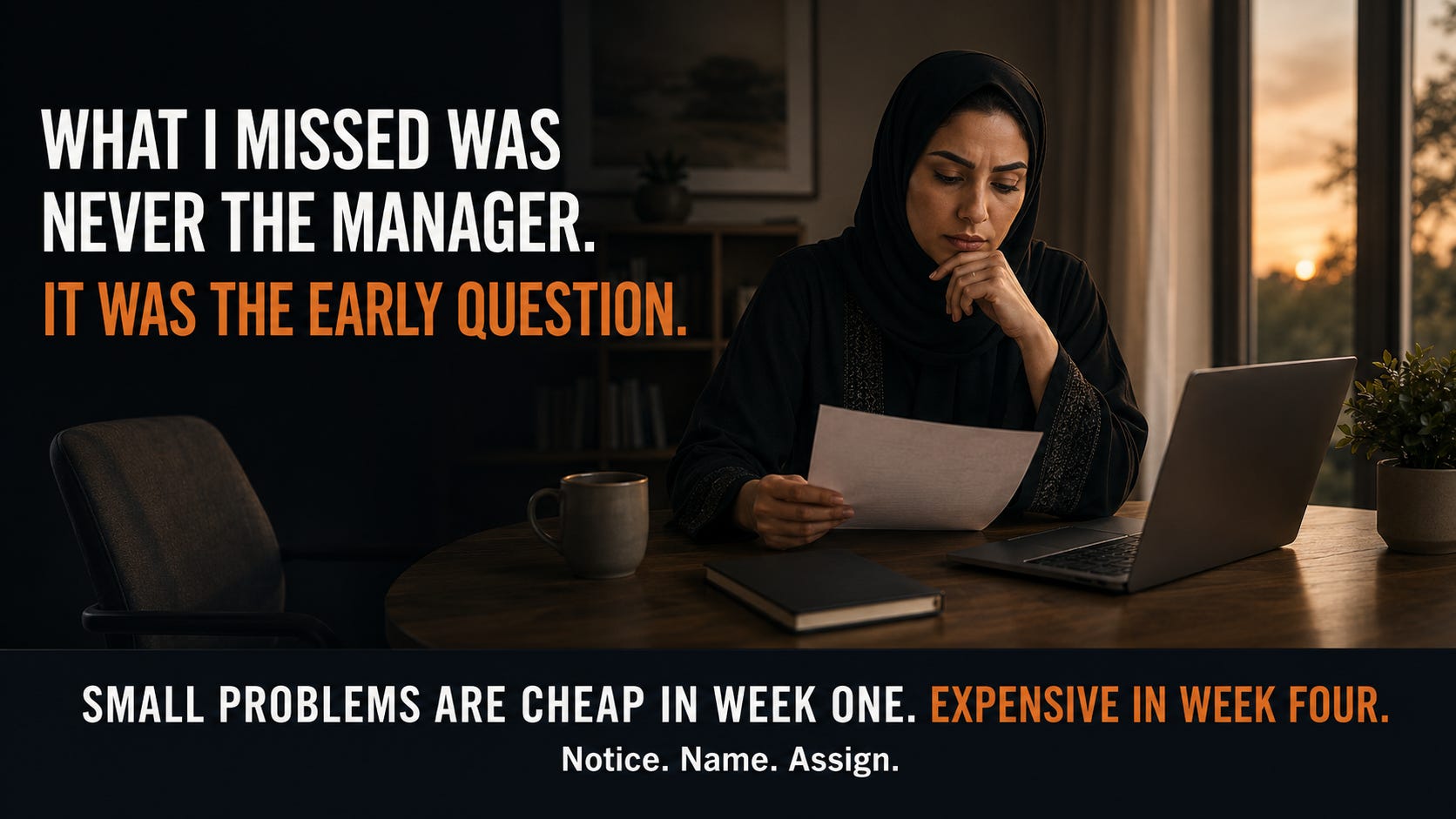
A good manager does one thing that is easy to mistake for oversight. They look at what you are building and ask the one question you had not thought to ask yourself, the question that comes from having seen your situation a dozen times before. Asked in week one, that question is cheap. Asked in week four, it is expensive.
It was never the check-ins for their own sake. It was a specific, well-aimed question, arriving early enough to still be cheap to answer. Remote work did not make you less disciplined. It removed the person whose job was to ask.
Two Things The Research Gets Right
The standard advice for staying on track alone is some version of try harder. The research says the fix lies elsewhere entirely.
Willpower was never the variable. Psychologists Veronika Job, Carol Dweck, and Gregory Walton, in a 2010 study published in Psychological Science, found that people who did not believe self-control was a limited resource showed no drop in self-control after a demanding task. People who believed the opposite showed the classic depletion pattern. The failure we call running out of willpower is partly a belief doing the work of a fact. Your manager’s question was never a patch for weak discipline. It was a second source of judgment that did not depend on what you believed about yourself that week.
A plan beats a promise. Psychologist Peter Gollwitzer built decades of research on implementation intentions, the habit of deciding in advance exactly when, where, and how you will act, rather than just deciding to act. A 2006 meta-analysis by Gollwitzer and Paschal Sheeran, published in Advances in Experimental Social Psychology, synthesized dozens of studies and found a medium-to-large effect on actual goal attainment. A manager’s question does this without either of you naming it. “What are you doing about the hard part?” cannot be answered with “I will get to it.” It forces a when, a where, and a how.
Put those two findings together, and the shape of the fix becomes obvious. You do not need more willpower. You need a specific question, asked on a schedule, by somebody other than the version of you that is avoiding the work.
The Early Question Framework
Here is the practitioner version: three frames you can run through in under five minutes, any day you feel the slide starting.
Frame One. Notice. What have I pushed to tomorrow more than once this week? Name the task, not the feeling about it.
Frame Two. Name. What question would a good manager ask me about this, right now, today? Write the actual question, not a vague resolution to do better.
Frame Three. Assign. Who is going to hear my answer, and when? A calendar block with no witness is a wish. A question with a named person and a day attached is a system.
Run all three, in order, and you have rebuilt in five minutes what an office used to give you for free.
The Fake Version To Watch For
A tracking system can become a performance of the question rather than the question itself, just as showing up in the office for an hour just to be seen satisfies the appearance of commitment without its substance.
A weekly report that only ever says “good week” is a fake version with extra steps. Frame Three only works if the answer is allowed to be uncomfortable.
A Final Frame
The manager who used to walk past your desk was never really checking on you. They were catching a small problem while it was still cheap to fix.
I did not miss the meetings. I did not miss the reviews. I missed the question, asked early enough to matter, by somebody paying attention on my behalf.
Nobody is asking it for you now, unless you decide who does. Run the three frames, and it keeps asking long after the manager who used to do it for free is gone.
A version of this story ran first at Thrive Remotely, a publication for people building careers without an office around them. Subscribe here: Subscribe to Thrive Remotely
Dr. Deepak Bhootra spent 34 years in leadership roles and 14 years as an ICF-certified coach, touching the lives of 1,500 people. Those learnings led him to found RISEUP@work, a career operating system that accompanies professionals throughout the full arc of their working lives, organized into three stages: Launch, Foundation, and Dividend. RISEUP@work is raising capital now, with a minimum investment of $100 to keep participation broad. Invest at wefunder.com/riseupatwork.