


The Walkman Move
Mitesh Agarwal, a former colleague of mine, wrote a piece titled “The Walkman Principle.” He named it after Akio Morita’s 1979 decision to rip the recording circuit out of a modified dictaphone, a move that terrified his own sales team. Anything more would have made the device too heavy to actually carry. Sony sold 400 million Walkmans.
The lesson Mitesh draws is sharp. Most executives do not have a time management problem. They have a tolerance problem. They quietly accept the meetings, the threads, the recording circuits that everyone else tolerates, and call the result a busy life. Read his piece. It is worth your fifteen minutes.
Mitesh applied the principle to the calendar. I want to take it a step further, into the career itself. That is a leap, and I will say so up front. His piece is about the day. This is about working life. But the underlying move is the same, and it shows up so cleanly in a career that it is hard to ignore.
Sitting with his piece over my morning tea here in Houston, it hit me that people do exactly the same thing with their careers as Mitesh describes for their calendars. They spend time and energy on the nice-to-haves and quietly skip the need-to-haves. They do things for their own sake, rather than things that move the dial on the outcome. The Walkman move belongs inside a career, not only on a calendar.
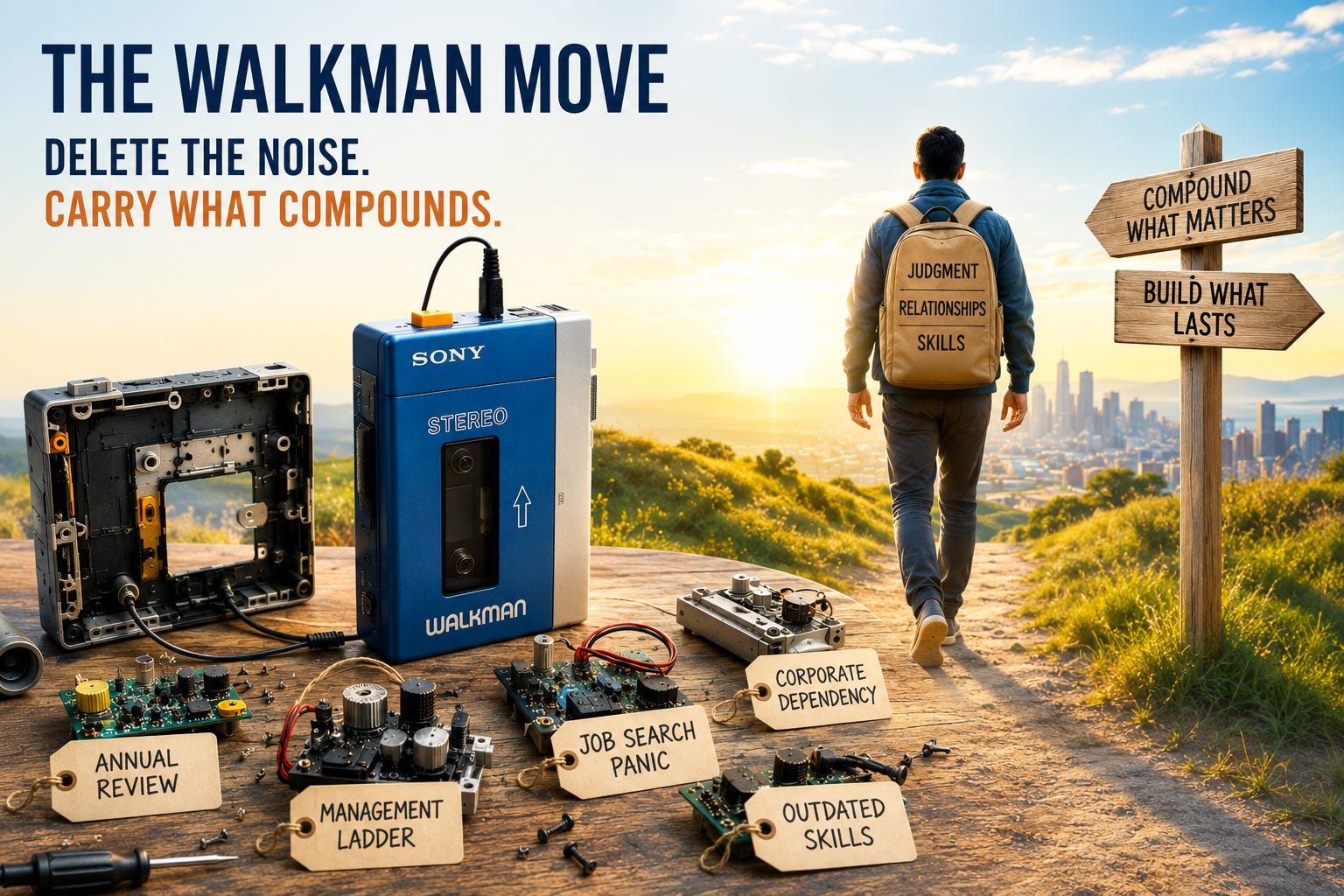
What Careers Quietly Tolerate
Think about what gets carried into a career and is never questioned.
The annual performance review, a backward-looking autopsy on a year you can no longer change, gets accepted as the verdict on your progress. The climb into management is accepted as progress, even now that the management layer is the first one AI is automating. The job search is accepted as the only moment to think seriously about your career, even though it happens once every few years and forces you to negotiate from the back foot. The skills you sharpened five years ago get accepted as the skills you have today, even when the market has moved on without telling you. The story that the company will steward your growth is accepted, despite four decades of evidence that it never really did.
These are not minor habits. They are the recording circuits. Each one looks reasonable in isolation. Together, they make the device too heavy to move. The career drifts, not because the professional lacks effort, but because they keep tolerating the noise that everyone else tolerates and call the result a career.
The Ruthlessness That Compounds
Mitesh quotes Drucker. There is nothing quite so useless as doing with great efficiency something that should not be done at all. The career version is sharper still. There is nothing quite so expensive as climbing efficiently up a ladder that no longer leads anywhere.
The professionals who compound are doing what Mitesh describes, but for their careers, not their calendars. They have quietly stopped tolerating the things their peers still tolerate. They do not wait for the annual review to tell them how they did. They do not climb into management for the title alone. They do not let the offer letter be the only moment they think strategically about their value. They have ripped out the recording circuit.
Specifically, they replace it with three habits.
First, they keep a continuous read on themselves, not an annual one. They look at where they stand, where they are pointed, and what is actually blocking them, several times a year, while there is still time to do something about it. They have moved from an autopsy to a diagnostic.
Second, they build value in the role, not just through the role. They use the current job as the studio for the next decade, not the platform for the next promotion. They invest where their judgment, relationships, and authority compound, not where their title decorates.
Third, they own the asset directly. They stop outsourcing the most expensive thing they have, the career, to a company that has every reason to optimize it for itself rather than for them.
What That Actually Looks Like to Delete
If this is going to be more than a thought, name what you are ripping out. The mental dependence on the annual review as your performance signal. The reflex that says every honest conversation about your career has to wait for a job search. The belief that the next title is the next progress. The assumption that someone else is keeping track of your growth. The library of half-read career books that has never been turned into a system you actually run. These are the recording circuits inside a career. Delete them, and the device gets light enough to actually carry into the next decade.
Why This Is About to Get Louder
The Walkman Principle has a hard edge under AI. When agents commoditize the output, the noise around the work no longer hides anything. Tolerating a backward-looking review used to be inefficient. It is now structurally dangerous because the review measures exactly the work AI now does, and tells you almost nothing about the things AI cannot do, which is the judgment underneath. The tolerance problem becomes a survival problem. The professional who keeps tolerating the noise is like carrying the recording circuit into a market that no longer wants it.
What We Are Building
The reason this piece lands so hard for me is that it is the company I am building. RISEUP@work is, at its core, the Walkman move applied to a career. A continuous diagnostic instead of an annual autopsy. A system for compounding career net worth across the full arc, not a series of resume optimizations. A way to rip out the noise other professionals tolerate and double down on the one thing that pays out across the next thirty years, the asset that is you.
Mitesh’s piece was about deleting half your calendar. This one is about deleting half the assumptions you were handed about how a career is supposed to work. The Walkman Principle scales further than the calendar. It scales to the whole working life.
If you are here, then let’s thank Mitesh. He named the move. We are building the system that lets you make it on the one asset you will own across every job you will ever hold.
Dr. Deepak Bhootra spent 34 years in leadership roles and 14 years as an ICF-certified coach, touching the lives of 1,500 people. Those learnings led him to found RISEUP@work, a career operating system that accompanies professionals throughout the full arc of their working lives, organized into three stages: Launch, Foundation, and Dividend. RISEUP@work is raising capital now, ahead of a revamped platform build aiming for a July launch, with a minimum investment of $100 to keep participation broad. Invest at wefunder.com/riseupatwork.