


The asset you never learned to manage
Your career is the largest asset you will ever own, and almost no one manages it like one.
Look at the number. Across a working life, a professional earns somewhere between one and ten million dollars, more than most homes, most portfolios, and most inheritances people will ever see. Yet the same person will spend a weekend researching a used car and not one deliberate hour on the thing that pays for the car, the home, and everything else.
I want to give that blind spot a name. Careeronomics. The idea that a career obeys the same laws as money, and that once you can see them, you can run it the way a careful investor runs capital.
Five laws matter most.
Law one: you are holding human capital, and it compounds
Economists call the skills, knowledge, and judgment you bring to work human capital, a concept developed over decades since Gary Becker first formalized it. It behaves like any other capital. You invest in it, it earns a return, and it wastes away if you neglect it.
The word that carries the weight is compounds. Skills built early do not sit there waiting. They compound on themselves because each capability you own makes the next one faster to acquire. A career works less like a salary you collect each month and more like a balance that grows or shrinks with what you keep putting into it.
Law two: the compounding window is front-loaded
Here is the finding that should change how you spend your 20s and 30s.
Roughly 76% of all the wage growth you will ever see arrives in the first ten years of your career (Deming, 2023). For the median worker, real earnings climb about 65% between ages 25 and 35, then only 15% across the next decade, and then they essentially stop (Ozkan, 2023).
Read that slowly. The curve is not a straight line; you can start climbing whenever you finally get serious. Most of the lift happens early and then flattens for good, which is why people who start lower rarely catch up. The gap opens in the exact years when real growth is still on the table (Guvenen and colleagues, 2022).
At RISEUP@work, we call that stretch the Launch Stage and the Foundation Stage, the first ten years of work. It is the highest-interest account you will ever be offered, and it opens only once.
Law three: the return comes from moving and matching
So where does that early growth come from? Not from sitting still and waiting to be noticed.
A young worker holds around seven employers in the first ten years, and the gains from changing jobs account for at least a third of all early-career wage growth (Topel and Ward, 1992). Moving is how the market reprices you once you have grown.
The rest is matching. Of two identical professionals at the same company, the one who lands a manager who moves them into work that fits earns about 13% more within seven years and is promoted far more often (Minni, 2026). Growth depends as much on the seat you are in as on what you know.
Law four: the biggest loss is often the one you cause yourself
Every asset carries risk, and in a career, the sharpest risk is usually the one you trigger yourself.
Here is a pattern I have watched for twenty years. A talented, ambitious person lands under a demanding, assertive manager who pushes hard, gives blunt feedback, and sets an unreasonably high bar. Nobody ever gave them the taxonomy to tell a genuinely toxic manager from one who is simply exacting and will make them far better, so they reach for the only word they have. Toxic. And they leave.
In my experience across more than a thousand such situations, around 80% of departures cost the person both pay and network, and recovery took years rather than months. They sold the asset at the worst possible moment, early, when the base was small and had barely begun to compound.
The research agrees in colder numbers. A single badly timed exit costs roughly two and a half years of earnings in present value and can leave someone about 20% poorer two decades later (Davis and von Wachter, 2011). Whether it becomes a shallow dip or a permanent setback usually turns on whether anyone helped them read the situation before they reacted. That reading is exactly what a coach, or a system built to provide one, exists to give.
Law five: the asset depreciates, and the rate just went up
Capital wears out, and skills are no exception. What made you valuable five years ago loses value as the work around it changes, and AI has accelerated that decay sharply.
That does not make investing pointless. It makes constant reinvestment the whole job. The people who hold their worth keep adding new capabilities faster than the old ones fade. Coast for a couple of years, and you are going backward even while you are still fully employed. I wrote more about that erosion and how to guard against it in the piece titled "On the Edge: No Model Can Hand You.”
The point of all this
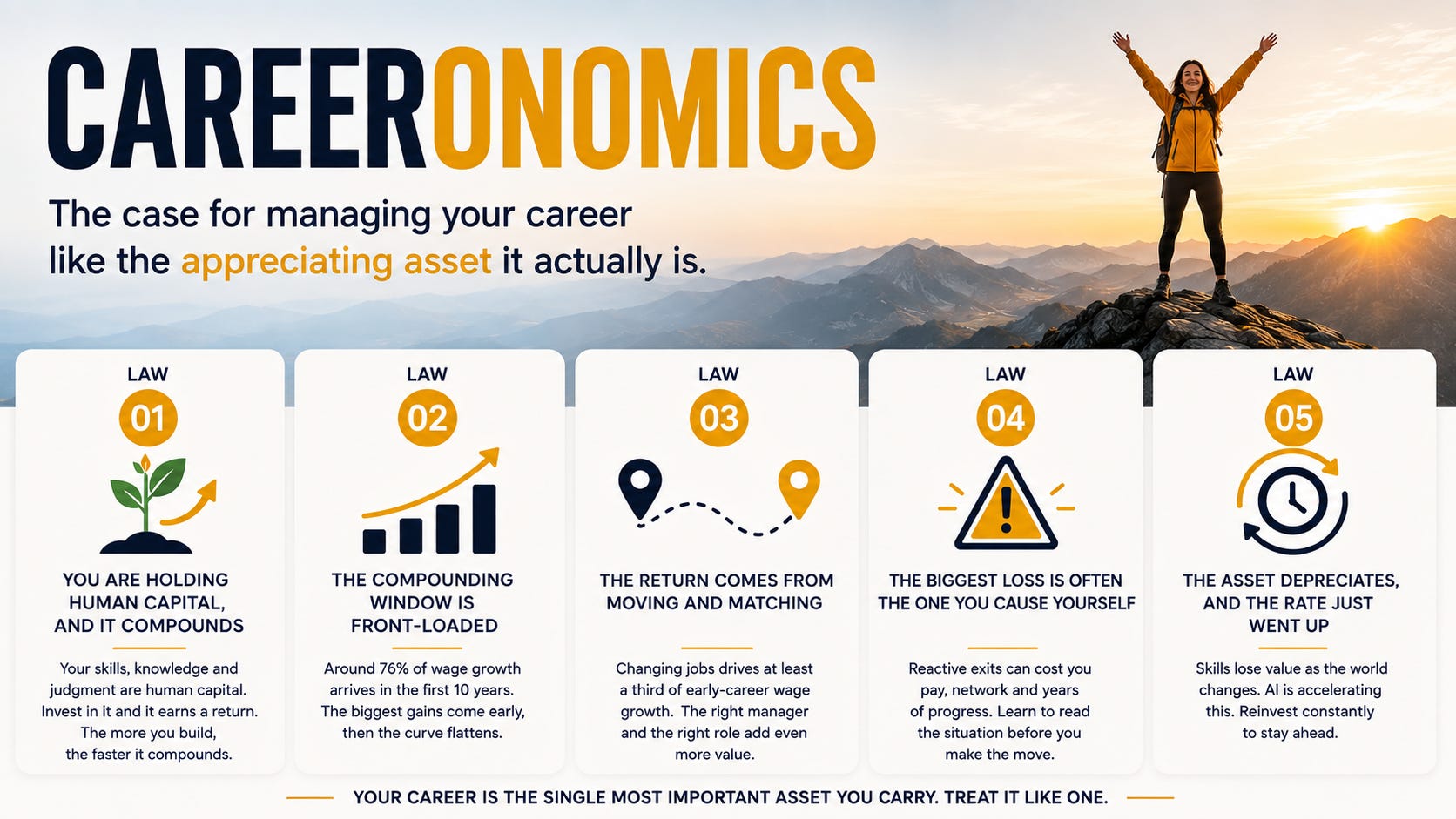
Put the five laws together, and the strategy writes itself. Invest early, while the window is open. Grow the real skill underneath the title. Move when you have outgrown the price you are being paid. Steer into work that fits. Refuse the self-inflicted losses, above all, the reactive exit you take before you understand the manager in front of you. And never stop reinvesting, because the depreciation clock does not stop either.
Almost none of this is taught. We hand people resume tips for the single day they get hired, then leave them to manage a seven-figure asset with no strategy. That is the whole reason I built RISEUP@work. Your career is the one asset you carry across every job, every title, and every detour, and it deserves to be run like one.
So treat the first decade as what it really is. The opening years of the most valuable account you will ever hold. What you deposit now is what the rest of your working life gets to compound on.
Dr. Deepak Bhootra is the Founder and CEO of RISEUP@work. He spent three decades as a senior leader within Fortune 100 companies across four countries, earned a doctorate studying what drives professional satisfaction and commitment, and has spent 13 years as an ICF-certified coach across more than 1,500 coaching relationships. RISEUP@work turns that experience into a career progression platform built for the growth that begins after you are hired. It is live and welcoming early adopters at riseupatwork.com.
Ready to manage your career like the asset it is? Join RISEUP@work and start building.