


The Reframe
Watch an actor before they walk on stage. By the time the spotlight finds them, the performance is already largely complete, and what the audience sees is the harvest of work done in the wings. A career works exactly the same way, but the labels we hand to professionals (early-career, mid-career, late-career) describe how recruiters sort you, not how you become great at the work. This piece is about the vocabulary we built when we stopped accepting their boundaries as ours.
Part 1. Two Lenses, Two Very Different Careers
There are two ways to look at a working life.
The first is the recruitment lens. It asks one question. How hireable are you right now? It sorts you into early-career, mid-career, and late-career. It is the lens of the talent acquisition team, the compensation benchmark, the LinkedIn filter, and the job posting. It exists to fill roles efficiently. It is excellent at that job.
The second is the development lens. It asks where you are in the architecture of a great career. It sorts by what you are building, not by how the market is buying. It is the lens of the person in the resume, not the person reading it.
When professionals adopt the recruitment lens as their own planning system, they accept its boundaries as their boundaries. The recruiter does not see you in college, so you assume nothing is happening yet. The recruiter does not assign a title to you until Year +15, so you wait until then to feel like you have arrived. Every one of those defaults is the wrong instrument speaking.
This piece is the lens swap. From a system that filters you to a system that builds you.
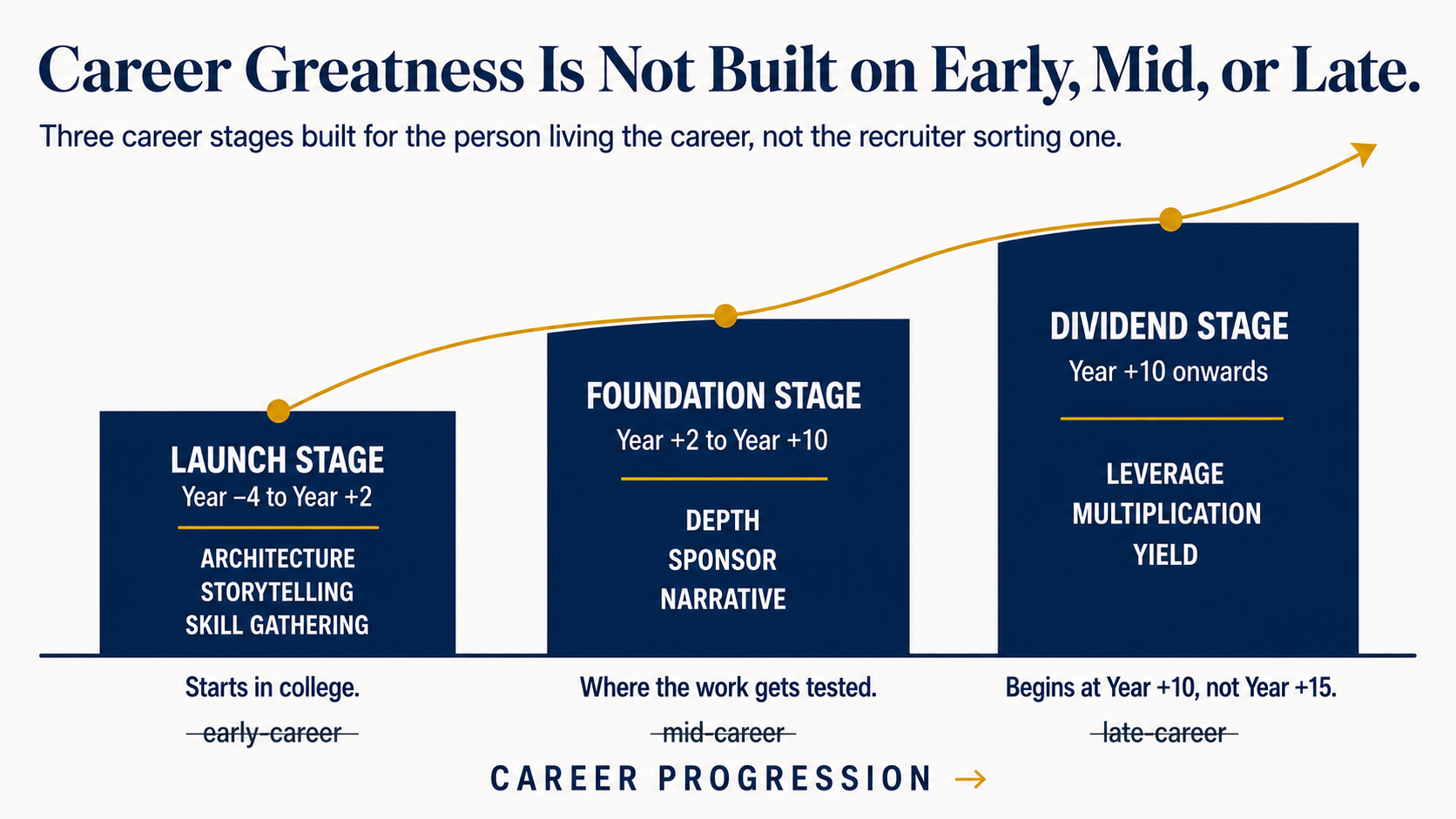
Part 2. Launch Stage Starts in College.
The Launch Stage begins in college, not on your first day at work. It opens the moment you start consciously architecting the professional you intend to become. The recruiter is not watching yet. Good. That invisibility is your most valuable resource. Use it.
Three things define wings-time. They are the only three that matter at this stage.
Architecture. The mental models you reach for when a problem is ambiguous. The ability to ask “what kind of problem is this” before “what is the answer.” Architecture is not what you know. It is the load-bearing scaffolding under everything you will ever learn. The graduate who has built it walks into work with an asset that compounds for 40 years. The graduate who has not spends the first decade catching up to it.
Storytelling. The ability to tell the story of your own work in real time, in a hallway, in a one-to-one, in a recommendation someone else writes because you gave them the language. Most professionals discover they cannot tell their story when it is too late. They reach Year +6 and realize they have no narrative arc, only a list of bullet points. You train the muscle in the wings, or you live without it.
Skill gathering. Range over specialty. The years before the main stage are when you should be sampling promiscuously. A second language. A coding stack. A design tool. A negotiation seminar. A writing habit. A foreign internship. A two-week side project that ships. Range purchased in the wings is the option pool you exercise in Foundation Stage, and the reason you do not panic when the market mutates underneath you.
Now, the part that will make some readers sit up.
The college student who treats their four undergraduate years as Launch Stage wings will graduate four years ahead of the one who treats those years as a runway to a job offer. The recruiter cannot see the difference on the first-day resume. The next ten years will see nothing but the difference.
Launch Stage runs from Year −4 to Year +2. Six years in the wings before the spotlight ever finds you. What the recruitment lens calls “no experience,” we call the most architecturally consequential window of your entire working life.
AI makes the wings more valuable, not less. A student in 2026 has access to a tool that the graduates of 2010 did not, and, used correctly, it compresses architecture, storytelling, and skill gathering by a factor of three to five. The Launch Stage native who treats AI as a sparring partner argues economics with a frontier model on Tuesday, rehearses a difficult interview on Thursday, and prototypes a side project on Saturday. AI is not a substitute for the work. It is the leverage that makes more of the work possible inside the same calendar. Same tool, opposite trajectories, depending on whether the student uses it to avoid the work or to multiply it. That is the variable that will decide who walks onto the main stage prepared and who walks on cold.
Part 3. Foundation Stage. Where the Work Gets Tested.
At Year +2, the wings end. The spotlight finds you.
Foundation Stage runs from Year +2 to Year +10. Eight years on the main stage. This is where the wings work gets tested in public. Weak architecture cracks here. Weak storytelling makes you invisible here. Thin skill stacks make you replaceable here. The professional who arrives prepared performs. The professional who arrives cold improvises poorly and is quietly surpassed by people who appear to be moving at an unfair pace. They are not unfair. They were prepared.
Three moves define the stage.
Depth. Pick one or two areas of genuine expertise and go deep enough that you become non-substitutable. Depth unlocks scope. Scope unlocks the rooms where compensation actually moves.
Sponsor. A mentor tells you what to do. A sponsor spends their political capital to put you in the room when you are not. The two roles are almost never held by the same person, and most professionals miss the distinction.
Narrative. Your manager has a manager. That manager sits in a calibration meeting. Inside that meeting, your name is mentioned, or it is not, with a story attached, or without. If you cannot tell the story of your own work, somebody else writes it for you, and it will not be the story you would have chosen.
AI changes the Foundation Stage math harder than it changes Launch. The move that used to take 18 months (becoming the in-house expert on a domain, drafting the position paper that gets your name into a room, building the strategic memo that earns a seat at a table) now takes six weeks. The AI-native uses the freed time to do the human work AI cannot do. Sponsor cultivation. Narrative drafting. The long lunch that changes a decision. The non-native does the same analytic work in months and never reaches the human work at all. The gap that opens between AI-native and AI-ignorant professionals between Year +3 and Year +6 defines the rest of the decade. It is quiet at first and permanent by Year +8.
Part 4. Dividend Stage. Why It Starts at Year 10, Not Year 15.
This is the question most readers do not ask but should.
The traditional recruitment lens does not call you senior until Year +15. Director. VP. Partner. So why does our system mark the Dividend Stage starting at Year +10? Five years earlier.
Because we are not measuring titles. We are measuring the trajectory.
By Year +10, the architecture is set. The wings work has either been compounded into Foundation work or not. The professional who built well in Years −4 to +2 and tested well in Years +2 to +10 is now sitting on a body of work that pays out automatically. Their name circulates in rooms they are not in. Their judgment is sought before their hours are. Their next role is offered, not applied for. The asset has begun producing returns.
That is the start of the Dividend Stage. It does not need HR’s permission. It does not need a title change. It is a structural property of a career, not a designation in a job description.
The recruitment lens waits until Year +15 because it is looking for the title. The development lens recognizes Dividend at Year +10 because it is looking for the asset.
There is a corollary here that nobody likes to hear. The first 10 years of work correlate strongly with what happens in the Dividend Stage. Not perfectly. Strongly. The professional who reaches Year +10 without architecture, narrative, or depth does not enter the Dividend Stage at Year +15. They enter a plateau. The recruitment system covers the plateau with a title and a corner office. The development lens sees what is actually happening. The cause has finished running. The effect is now visible.
That is why we count the dividend from Year +10. Not because the title is there. Because the cause has finished running.
At the Dividend Stage, AI shifts from compressor to multiplier. The native turns one book into a course, a fellowship, a podcast, and a public framework, all without proportional hours. The non-native at the same career age is still selling hours, and the resulting yields are not remotely comparable.
Part 5. Where You Are Right Now.
The question “where am I in my career” produces a different answer depending on which lens you ask. The recruitment lens reads your resume and reports a number of years next to a category label. The development lens asks what you built in the wings, what you tested on the main stage, and what your work is now paying out. The same professional gets two different answers from the two lenses, and the one that compounds across forty years is almost never the one printed on the resume.
If you are still in college, your Launch Stage is happening right now, even though no recruiter can see it yet, and that invisibility is the most undervalued asset in professional life. AI has made it more valuable, not less, because it lets a focused undergraduate condense years of architectural, narrative, and skill-building work into a single calendar window. The recruiter will not see the gap on day one, but the next ten years will see almost nothing else.
If you are in the first decade of your career, the operative question is whether your wings work is holding up under the lights. At Year +5, the next five years will compound either the preparation you built or the deficit you arrived with, and AI decides only how fast that compounding moves, not which direction it runs. By Year +10, the compounding has already produced its result. The asset is either beginning to pay out, or you are entering a plateau. The traditional system will dress the plateau in a title and a corner office and call it senior, while the development lens names what is actually happening, because naming it is the only way to act on it.
The recruitment lens sorts you for hiring, and the development lens builds you for greatness. These three stages do not replace the recruiter’s vocabulary so much as they replace its grip on how you think about your own time, your own preparation, and your own arc. That is the lens, and that is what RISEUP@work was built to install.
Dr. Deepak Bhootra is the Founder and CEO of RISEUP@work, a career operating system built for professionals across the full arc of their working life, from the wings to the dividend phase. He writes weekly about adaptive intelligence, career navigation, and the new shape of work.
I love this framework, Dr. Deepak. What you are essentially pointing out is that growth starts way before you officially start your career. And, since growth is exponential, you don't see much happening in the first few years.. but you are building the skillset and mindset for future success.
That is how compounding works.. in financial investments, careers, relationships. Great article, thanks for sharing.