

The Phrase That Is About to Change
For the last decade, the rallying cry has been “build your own career.” It was a self-help slogan with a stack of books behind it. The phrase is about to evolve into something far more structural.
Bring Your Own Career.
The natural step after Bring Your Own AI, which is already the new shadow IT of the 2026 workplace. It is the frame, I believe, that will define how professionals operate by 2028.
The Two Trends Colliding
Two trends are running in parallel right now, and almost no one is putting them side by side.
The first is that companies have quietly cut back on developing their people. L&D budgets have shrunk for three years. Entry-level headcount in the most AI-exposed lanes has fallen by 16%, according to the Stanford Digital Economy Lab. The “earn-while-you-learn” model that built the last several generations of experienced professionals is, as the data now shows, “finally broken in some occupations.” I wrote about that collapse in The Apprenticeship Bridge Is Burning and, more recently, in The Convenient Scapegoat. The structural truth is the same. The employer is no longer the steward of the career.
The second trend moves in the opposite direction. AI is making individual leverage portable across employers in a way that did not exist five years ago. Professionals are bringing their own AI stack into the office every morning, using it on company data, company email, and company customer conversations, often without the company sanctioning it. This is Bring Your Own AI, and it is the new shadow IT. IT departments will spend two years trying to contain it and will mostly fail, because the productivity differential is too large to give up. The AI that holds the professional’s voice, patterns, judgment, and best work does not belong to the company. It rides with them.
Put those two trends next to each other, and the picture is clear. If the company will not steward the career, and the AI rides with the professional, the career itself becomes a portable asset. Bring Your Own Career.
What BYOC Actually Looks Like
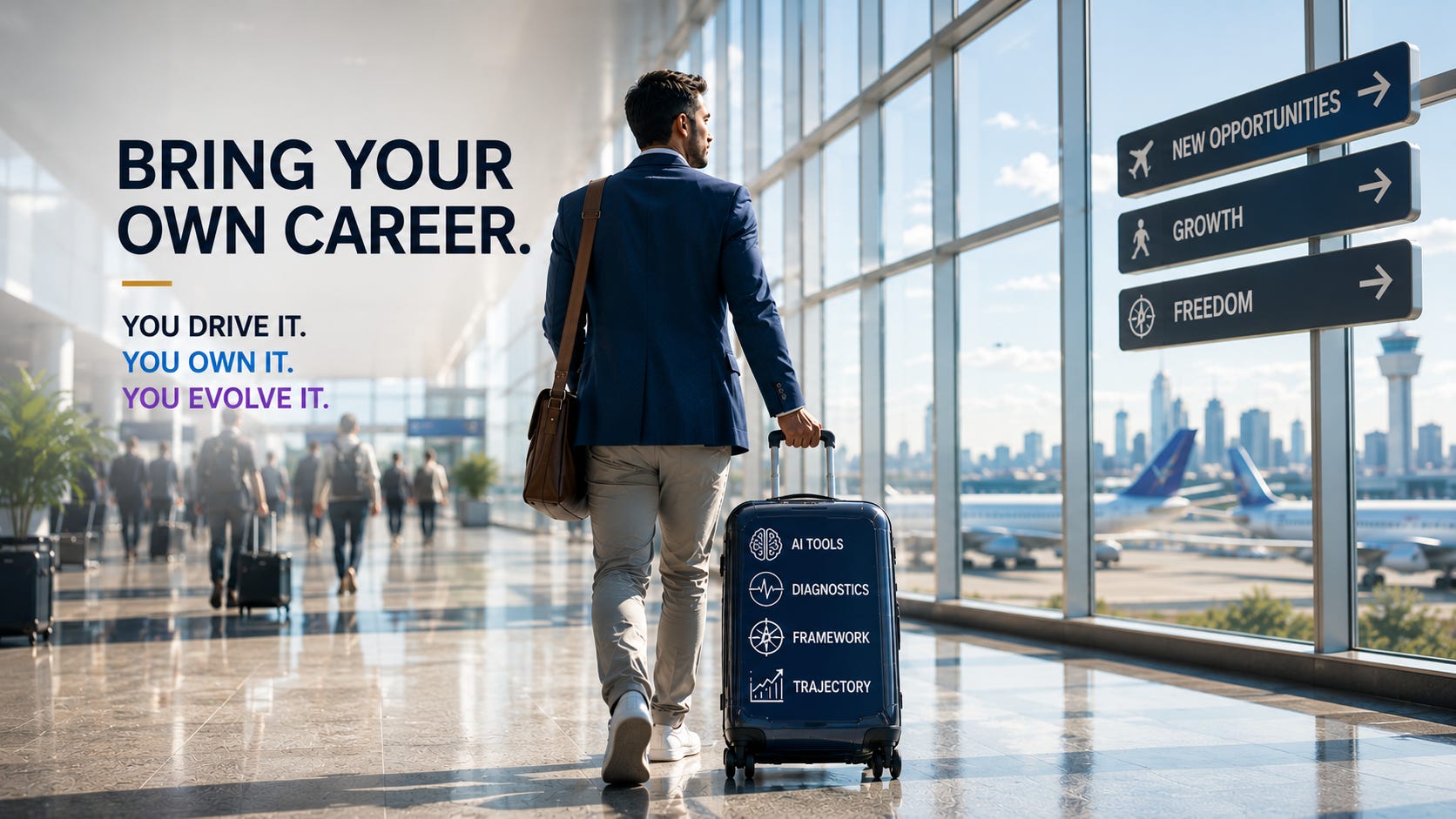
The phrase only works if it points to something concrete. The BYOC professional shows up to every employer relationship with four things they own.
Their own AI. The tools, prompts, workflows, and personal knowledge base they have been building. The next employer does not give them these. They bring them.
Their own diagnosis. A continuous read on where they stand, where they are pointed, and what is blocking growth. It runs alongside the work, all the time, rather than depending on the annual review, which I have argued elsewhere is an autopsy of a year already ended.
Their own framework. A way of thinking about progression that does not depend on the company’s career ladder, which is increasingly leading to the layer that AI automates first. I wrote about that middle-of-the-ladder collapse in AI Is a Threat to Your Job. But a Bigger Threat to Your Promotion. The BYOC professional has their own three-stage frame, their own measure of career net worth, their own definition of progress.
Their own continuous reading of the trajectory. Not a five-year plan written for a manager, but a live sense of where they are heading that updates with the data, the market, and their own judgment.
These four together turn the career into something the professional carries with them. The employer is one of several environments where the BYOC professional deploys what they already own.
What I Think Happens in Eighteen to Twenty-Four Months
The first wave of professionals operating this way is already in the wild. They are quiet about it because the language for it does not yet exist. Inside the next eighteen to twenty-four months, three things happen in sequence.
First, BYOC enters the language. Someone in the HR press picks it up. The phrase travels. People operating this way recognize themselves in it.
Second, the first BYOC professionals are starting to show up for interviews differently. Paul Allen mapped what ‘Bring Your Own Agents’ looks like on the input side, the professional walking into work with the AI stack that runs the day. BYOC is the larger frame. The BYOC professional uses their own AI, diagnostic framework, and continuous reading of their trajectory to prepare for the room. They walk in already clear on what they bring, what they are choosing between, and the questions that will tell them whether this environment fits their arc. The employer is meeting someone sharper, more deliberate, and quietly running their side of the conversation, not a candidate showing them a deck.
Third, the smartest employers stop fighting it and start hiring for it. In the same way smart companies stopped fighting Bring Your Own Device (BYOD) fifteen years ago and started designing for it, the smart employers of 2028 will design for BYOC. They will compete on which environment lets the professional compound the fastest, rather than which one locks them in.
The rest will keep negotiating the old contract and quietly lose the talent they wanted most. I argued the prelude in The Corporate Deal Is Dead. The deal collapsed. BYOC is what replaces the dependency it used to create.
What This Means for the Professional Reading This
If I am right about the timeline, the implication is straightforward. The career operating system you build over the next eighteen months becomes the asset that decides which curve you sit on. The professional who has not built it will be negotiating with HR from a position that no longer rewards the structure. The one who has built it will be choosing among employers, and choosing which environment compounds them fastest.
This is what I am building at RISEUP. The career operating system for that career, across the full arc of a working life, is organized into three stages: Launch, Foundation, and Dividend. It pairs a continuous diagnostic with AI tools, human coaching, and a peer community, all designed so the professional owns the asset rather than rents it. The revamped platform launches this July.
The professionals who will be operating this way in 2027 are already doing so quietly in 2026.
The Ideas I Am Wrestling With
These are the ideas I am wrestling with. The trends are colliding faster than the conversation can keep up with. Bring Your Own Career captures what I see across the desks I sit at, the founders I advise, and the professionals I coach.
If you have been thinking about this from a different angle or have already run a system like this on yourself, I want to hear from you. The next decade of careers will be shaped by who recognizes this transition first.
RISEUP.
Dr. Deepak Bhootra spent 34 years in leadership roles and 14 years as an ICF-certified coach, touching the lives of 1,500 people. Those learnings led him to found RISEUP@work, a career operating system that accompanies professionals throughout the full arc of their working lives, organized into three stages: Launch, Foundation, and Dividend. RISEUP@work is raising capital now, ahead of a revamped platform build aiming for a July launch, with a minimum investment of $100 to keep participation broad. Invest at wefunder.com/riseupatwork.