

Two managers, one territory, the same tools
Over the past few weeks, nearly two hundred people joined multiple sessions of a free lesson we ran on Maven, called Using AI Without Losing Your Edge at Work. We also asked each of them to complete a short questionnaire on how they actually use AI from day to day. Their answers, and one afternoon in a review room, are why I am writing this.
I have spent most of my working life in and around sales. Territory reviews, pipeline reviews, quota fights, the lot. I have sat in that chair more times than I can count, so understand that I am not easily surprised in it anymore.
Then a few weeks ago, I was.
We asked two sales managers to analyze their territory and walk us through it. One was running a territory for the first time. The other was on his second. Same brief, same data, same tools. And both of them, like almost everyone now, leaned on AI to build the analysis.
The decks came back. Both were good. Genuinely good. Clean, well structured, confident, full of the right numbers and the right language. On the slides, you could not tell the two apart. For a few minutes we thought we had two strong managers on our hands.
Then we started asking questions.
How did you size the territory, and what drove that number?
How does this year’s performance compare to last year, and why?
Are there any overhang or shadow commitments sitting under the surface that we should know about before we trust these figures?
Ordinary questions. The ones any sales leader asks in their sleep.
Here is the part worth sitting with. The answers came. It was not that the first-time manager froze or had nothing to say. He answered. But the answers arrived thin. They sat right on the surface, and the moment we pushed one layer past what the AI had assembled, there was nothing underneath to stand on.
The second-time manager was different. Not slicker. Deeper. He had wrestled with his own numbers. He knew exactly why the territory was sized the way it was, where last year’s shortfall really came from, which commitments were soft and which were real. The AI had helped him build faster. The judgment underneath it was his, and he could defend it from any direction we came at him.
Same tools. One had used AI to do the work. The other had used it to skip the work. On the page, that gap was invisible. In the room, it was the entire story.
The artifact stopped being the proof
Here is what shifted for me that afternoon. For my whole career, a polished deliverable was proof of something. A tight territory analysis meant a capable person had done the grind, because the grind was the only way to produce it. That link is now broken. When anyone can generate an expert-looking artifact in minutes, the artifact tells you almost nothing about the person who handed it in.
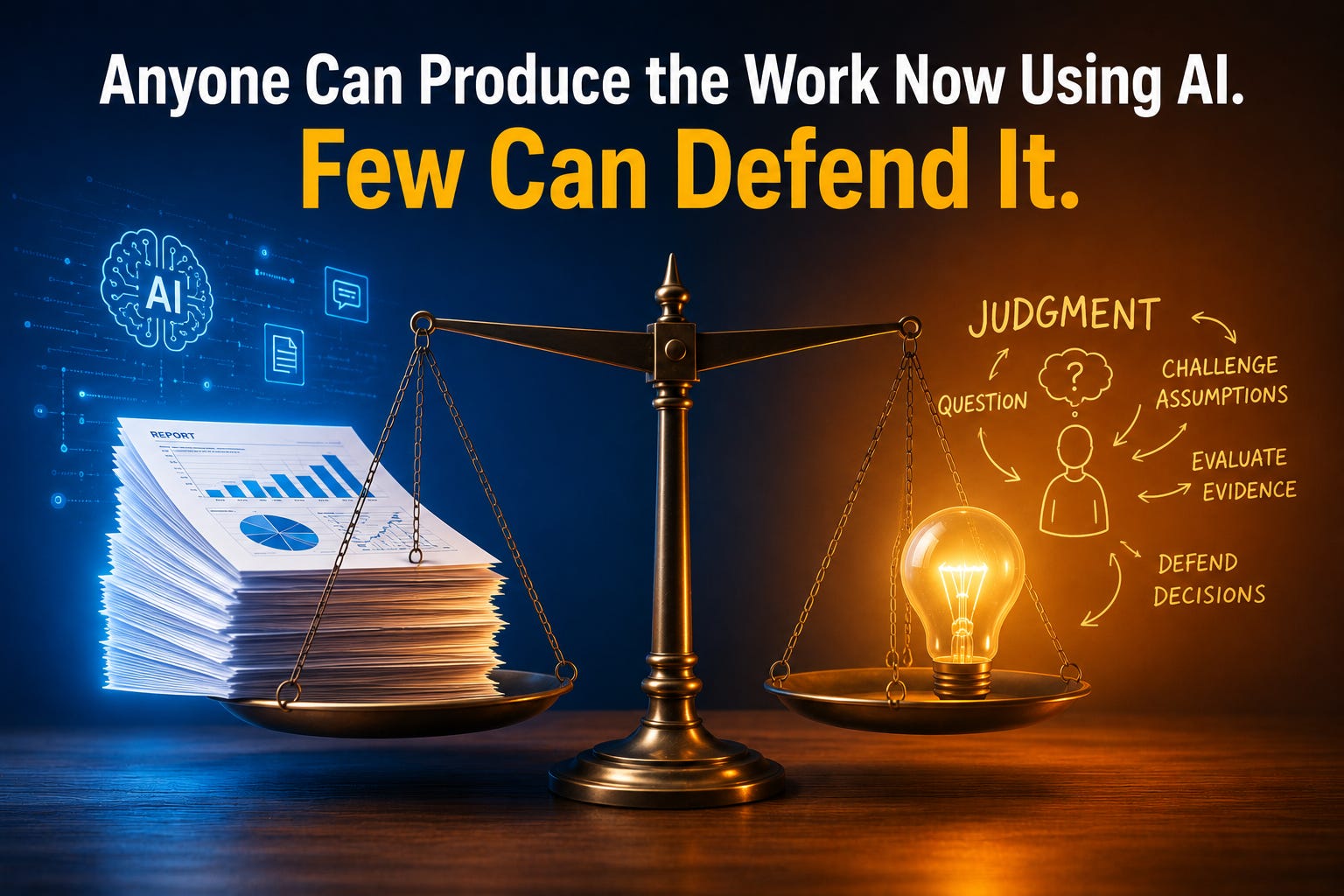
So the test moved. From what you can produce to what you can defend. From the deck to the thinking behind it. And thinking does not fall out of a prompt. It comes from having done the hard reasoning yourself, enough times, that you can hold your ground when someone who knows the field starts pulling at it.
Which leaves an uncomfortable question hanging over that first-time manager, and over a whole generation walking into work right now. If you outsource the thinking from the very start, what happens to the judgment that was supposed to grow there.
The research is starting to say it out loud
For a while I treated this as a hunch from the review room. The research is beginning to say it is more than that.
Microsoft and Carnegie Mellon surveyed knowledge workers on how generative AI shapes their thinking. The more people trusted the tool, the less critical thinking they did. They named the trap precisely. Hand the routine work to a machine and you also strip away the everyday reps that used to build judgment, leaving people, in their words, atrophied and unprepared when the hard exceptions finally arrive (Microsoft Research, CHI 2025).
MIT went and measured it. They put EEG caps on people writing essays. The ones leaning on an AI assistant showed the weakest brain engagement of any group, ran up what the researchers called cognitive debt, and often could not even quote back what they had written minutes earlier (MIT Media Lab preprint). The work was there. The person had barely shown up.
And a 2025 study in the journal Societies found a real negative link between heavy AI use and critical thinking, driven by offloading the mental load onto the tool. The effect was strongest among the youngest people in the study (Gerlich, Societies 2025).
Put those three next to my two sales managers and the pattern is hard to unsee. The people most exposed to losing their judgment are the ones earliest in their careers, because they are handing away the thinking before they ever built it.
Why this hits the early years hardest
Judgment is not something you are taught. You earn it. And you earn it through exactly the moments AI now lets you skip.
You build it by sitting with a number that does not add up until it finally does. By taking a position on your territory, getting challenged on it, and either defending it or changing your mind. By getting a call wrong and feeling why it was wrong. By the uncomfortable review where a leader asks the one question you cannot answer, and you walk out sharper than you walked in. That friction is not in the way of the work. It is the work. It is where intuition quietly gets made.
When someone early in their career uses AI to route around all of that, the polished output hides the fact that none of the forming happened. And because it looks fine, nobody flags it. It does not show up as a bad review. It shows up years later, as a capable-looking manager who cannot defend their own plan, cannot feel when a number is off, and cannot handle the exception the machine was never trained for. The convenience was real. The bill just arrives late, with interest.
Using AI without losing your edge
None of this is a case against AI. Used well it is a serious multiplier, and refusing it is its own career mistake. The line is easy to say and hard to hold. Use AI to execute your work. Do not use it to do your thinking.
Let it draft, and make yourself the editor, because editing forces you to have a view. Let it speed up the parts you already understand. Do the hard thinking yourself on the parts you do not, because that struggle is the entire point. Stay in the loop on anything that matters, since you cannot challenge an answer in a field you never learned. And early on especially, stop dodging the hard conversations. Walk toward them. They are the reps that build the one thing AI cannot hand you.
This is exactly why we built our Maven lesson, Using AI Without Losing Your Edge at Work. The professionals who will stand out over the next few years are not the ones who produce the most. They are the ones who can still think, and defend it, when the machine goes quiet.
If you want an honest read on where your own habits sit, from healthy leverage to quiet over-reliance, take the RISEUP AI-usage Diagnostic, the same short questionnaire our Maven participants used. You can find it at maven.riseupatwork.com/rad, and a few minutes will show you your own pattern clearly.
Your career is the one asset you carry across every job, and in an AI world its value is your judgment. The output is free now. The thinking behind it is the whole game, and it is still, thankfully, yours to build.
That is the reason RISEUP@work exists, and we have just launched. We are looking for early adopters, the people who would rather sharpen their judgment than quietly hand it away. Come and join us at riseupatwork.com, and as one of the first through the door, your first year of the Builder tier is on us.
Subscribe for more like this: https://riseupatwork.substack.com/subscribe
That is the whole reason RISEUP@work exists, and we have just launched. We are looking for early adopters, the people who would rather sharpen their judgment than quietly outsource it. Come and join us at https://riseupatwork.com, and as one of the first through the door, your first year of the Builder tier is on us.