

Where this started
I read Paul Allen’s piece twice this week. Paul Allen
It stayed with me. On the eve of America’s 250th birthday, he asked a simple question. If Franklin, Jefferson, and Washington were alive right now, what would they be building? Not tweeting. Not waiting on a committee to approve the next step. Building.
His answer is that the Founders were builders before they were statesmen. Franklin invented the lightning rod and founded the first public library and the first fire department. Jefferson designed a university and cataloged the books that seeded the Library of Congress. Washington ran one of the most productive farms in the country while commanding an army and then governing a nation. They saw gaps and closed them. That was the American tradition from the very start.
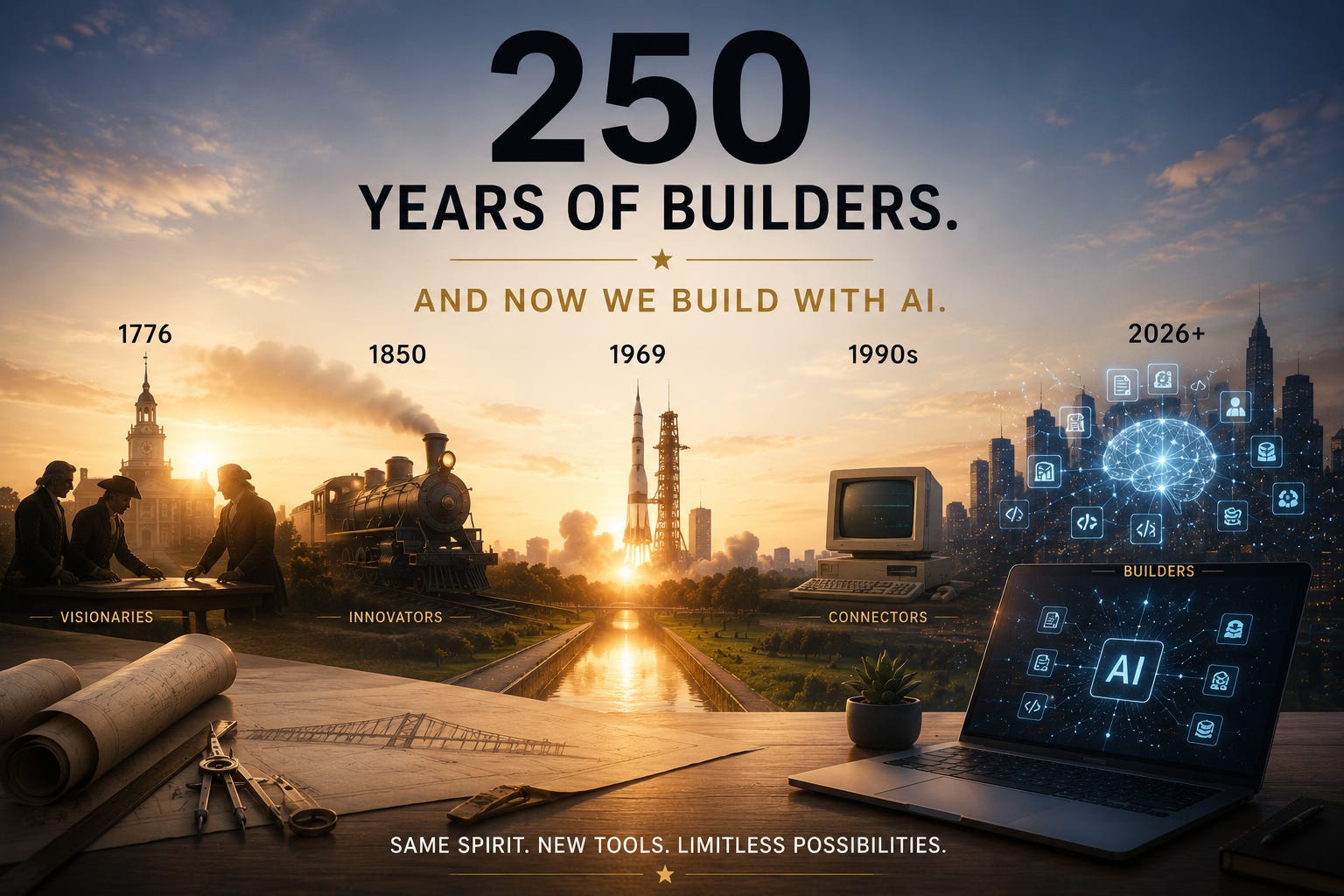
Then Paul draws the arc across 250 years. Franklin tamed electricity. Edison turned it into light. NASA turned math into a moon landing. The internet put the whole world inside a laptop. Every one of those leaps widened the circle of who got to build. His claim is that AI agent fleets are the next leap, finally putting real capability in the hands of anyone willing to learn to use them.
He is right. There is one part of it I want to push on.
The tool, and the person using it
Paul frames the agent as a capability. A way to do more, and to do it faster, at any hour. He is not wrong about that.
But look closer at Franklin, the man he picks first. Franklin was a tinkerer at his core. Printer, inventor, diplomat, scientist, civic organizer. The thread running through all of it was not output. It was learning. He tinkered because he wanted to understand, and he knew himself well enough to keep aiming that curiosity at the next useful thing, for sixty years.
What I hope for is something quieter. That people learn to see an AI agent as more than a faster way to get the work done.
Used well, it becomes a mirror. It shows you how you actually go about the work. Where you rush? Where you avoid the hard call. Where your thinking is sharp, and where it has gone lazy.
The agent handles the work. The work on yourself is the part that compounds.
Outer engineering and inner engineering
I have loosely called this outer engineering versus inner engineering.
Outer engineering is everything the agent can now do for you. The draft. The analysis. The schedule. The research was pulled together in seconds. That whole layer is getting cheaper by the month, and before long, it will be close to free.
Inner engineering is the harder build. Self-awareness. Judgment. Knowing where to point all that intelligence, and why. Knowing which problems are even worth solving. No agent does that part for you. It is yours to build or leave unbuilt.
Franklin had both. The tinkerer’s hands and the citizen’s judgment. What made him a one-man fleet was never the tools he had. It was knowing what deserved his attention.
A career is an asset
This is the work I spend my days on.
At RISEUP@work, we treat the career itself as the asset, not the role. The role is rentable. The title can be taken. A career is the thing you actually own across an entire working life. We are building the longitudinal system underneath it. By longitudinal, I mean the decisions made in the first decade of work that keep paying you back long after you have forgotten you made them.
AI works well inside that system. It cannot replace the system itself.
An agent can write your résumé in a minute. It cannot tell you who you are becoming while it does. That question lives one level up, in the inner engineering, and almost no one was ever taught to work there.
The promise of agents is real. It is also only half a promise. Speed without direction just gets you lost faster.
What the Constitution actually promises
Thinking about the US Constitution this week, something struck me that I had not put into words before. The American promise is not only about how the country presents itself to the world. The larger half of it points inward. It is about how a whole population brings out its own inner engineering.
That inner work is what produces love of country that is earned rather than performed. Respect for hard work is a real value, not a slogan on a wall. A stubborn belief that democracy, messy as it is, remains the right framework for a world that feels perpetually on fire.
The Founders not only designed a government. They designed people who would keep choosing to build it. That invention has to be renewed in every generation, by every person, from the inside.
Build like a Founder, in both directions
On this 250th birthday, I will borrow Paul’s word and hand it back to him.
Build.
Build the outer things. Deploy the agents. Close the gaps you can see. That opening is now there for a first-generation founder in a small town and a nonprofit director in a hard neighborhood, the same as it is for anyone in a corner office. That is the promise beginning to keep itself.
Then build the inner things too. The self-awareness. The judgment. The version of yourself worth handing all that new capability to.
Franklin would have grabbed the agents first. Then he would have used them to become more himself.
Happy 250th, America. Let’s build. Both engines.
Dr. Deepak Bhootra is the founder and CEO of RISEUP@work, a longitudinal career operating system for the first decade of working life, and the author of four books on work and human potential. RISEUP@work is currently raising on Wefunder at wefunder.com/riseupatwork.